Anhand eines bekannten Spieles wurde diese Geländespielform entwickelt.
Bei diesem Artikel handelt es sich um einen Forum Heft-Artikel und er ist vals PDF-Datei angefügt.
Make your own game
There's no such thing: yet another outdoor game on the agenda... what are we going to offer the children this time? Why not try something completely new? Take a well-known game template and use it to create your own game! In the following text you will find an example of what such a game could look like.
The idea
It all started with the idea of redesigning an outdoor game based on a well-known table game. It should be a game that offers both younger and older children an opportunity to spend an afternoon according to their age and interests.
The first step was to choose a game that most of the children were already more or less familiar with, in this case the table game commonly known as "Schiffliversänkis".
The original
In the original table-top version of this game, two players sit opposite each other. Each of them has two pieces of paper, each divided into approximately 15 x 15 squares of equal size. These squares are numbered like a chessboard from 1 to 15 on one side and A to Q on the other. In addition, everyone has five different colored crayons.
Each player now uses these crayons to draw their ships on the one sheet representing the sea: they can draw one ship in each color. Of the five ships, the smallest is two squares in size, the next largest is three squares and so on until the largest is six squares. The ships can be drawn anywhere on the sheet, but they must not overlap. It is important that the players cannot see their opponent's sheet under any circumstances.
Once the preparations have been completed, the big water battle can begin: One player begins and asks the other for a square on their board, e.g. C12 or L3 etc. If the other player has drawn a ship on the requested square, they must indicate this as a "hit". If this square is empty, the shot goes into the water. The questioner can now mark the requested position on his second sheet. Now the front changes and the questioner can try his luck.
The winner is the first player to locate, i.e. sink, all of the opponent's ships.
What became of it ...
In order to adapt the table game to the much larger dimensions of the forest and the considerably larger number of players, it is necessary to form four or more groups with the children.
First, find a playing area of approx. 50 x 50 m in slightly hilly terrain. At the corners, four posts are set up with barrier tape, which then represent the harbors in the game. The game sheets with the fields and the crayons can be used as they are originally intended.
In order to meet the different needs of the children, it is necessary to set up different task areas for this game, whereby the roles can still be swapped during the game.
As a quiet activity, two children per group are in the harbor during the game, monitoring the position of the opposing ships and informing the attacking players of the other teams about the occupancy of the required map squares. They are also the ones who plan and control the tactics and the course of their "attacks".
Another two children per group run to the opposing ports with the points they have collected, "attack the other ships" and then report the hits and misses to their home port.
The remaining children have the task of collecting "ammunition" for their team in various ways in the middle of the playing field. They are given two different types of game to do this:
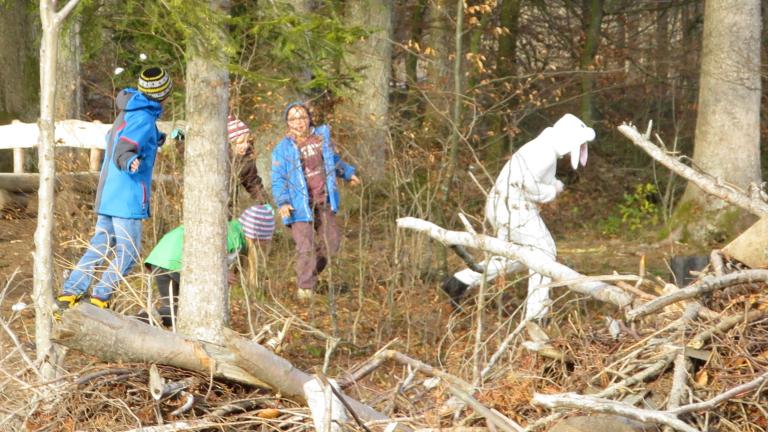
For the older, or scrappier children, there is the opportunity to compete in a ribbon fight. Each player receives a woolen thread tied around their upper arm and their goal is to tear the thread off the other players' arms. If a player loses his thread in this way, he has to get a new one from the leader at the edge of the field. It is important that clear rules are laid down for collecting points and that a leader constantly monitors the game, otherwise the necessary fairness is quickly forgotten in the zeal!
Younger children or those who prefer to avoid confrontation can collect chips scattered around the playing field (stuffing material, which is available in boxes from larger companies), which a leader continually scatters.
The wool threads or chips collected in this way are converted by a leader according to a fixed table (e.g. three wool threads = one shot, ten chips = one shot) and the number of points is given to the attackers. They take the points to their hen, where the attack is then launched.
The game ends as soon as a group has lost all its ships or, of course, when the children run out of breath or time is up.
Tips and ideas
Especially with older children, teenagers or even more groups, this game has a greater appeal if you add some tactics. For example, peace agreements between two groups and a joint attack approach can certainly have their appeal. This is especially true if the pact-makers realize at the end that their supposed agreement has been undermined by their opponent.
The difficulty level of this game can be changed at will according to the following factors:
- The more squares there are on the game sheet, the more challenging the search for the ships becomes
- A higher number of ships increases the probability of being hit
- The number of wool threads or chips required for a shot can speed up or slow down the game
- Ships in which the attackers have to "sail" to the enemy harbor can be represented with two sheets buttoned together.
To immerse the children even more in the world of sailors and pirates, you can of course also adapt the ambience accordingly: With headscarves, eye patches, made-up scars etc., each pirate crew can give themselves their own look.
As in this example, other well-known board and table games can also be converted into a terrain or city game. Have fun preparing!
Source reference

- Content and picture: Forum Kind issue 2/05, page 28 + 29. This type of terrain game was developed on the basis of a well-known game. © Copyright www.form-kind.ch
- Authors: Andi Flückiger and Stefan Schneider, leaders of the Henggart youth group
- Anmelden oder Registrieren, um Kommentare verfassen zu können