There are many different ways to conduct a reflection session.
The following ideas are useful for overcoming reluctance and avoiding one-sidedness.
Note
A reflection session is a good idea after any period of intensive work with a group – for example, after a youth group weekend, a mini-camp, or perhaps simply after a term of youth group activities.
This feedback is not just for the group leader, but for every single participant as well. An external assessment can be a valuable aid to the process of maturing.
Furthermore, the group is given the chance to grow from their shared experiences. Any conflicts that have arisen are discussed, lessons are learnt from mistakes, suggestions for improvement are sought, whilst positive aspects are praised and successes celebrated.
General information on reflection can be found in the article of the same name on YS-Wiki. (here)
personal reflection
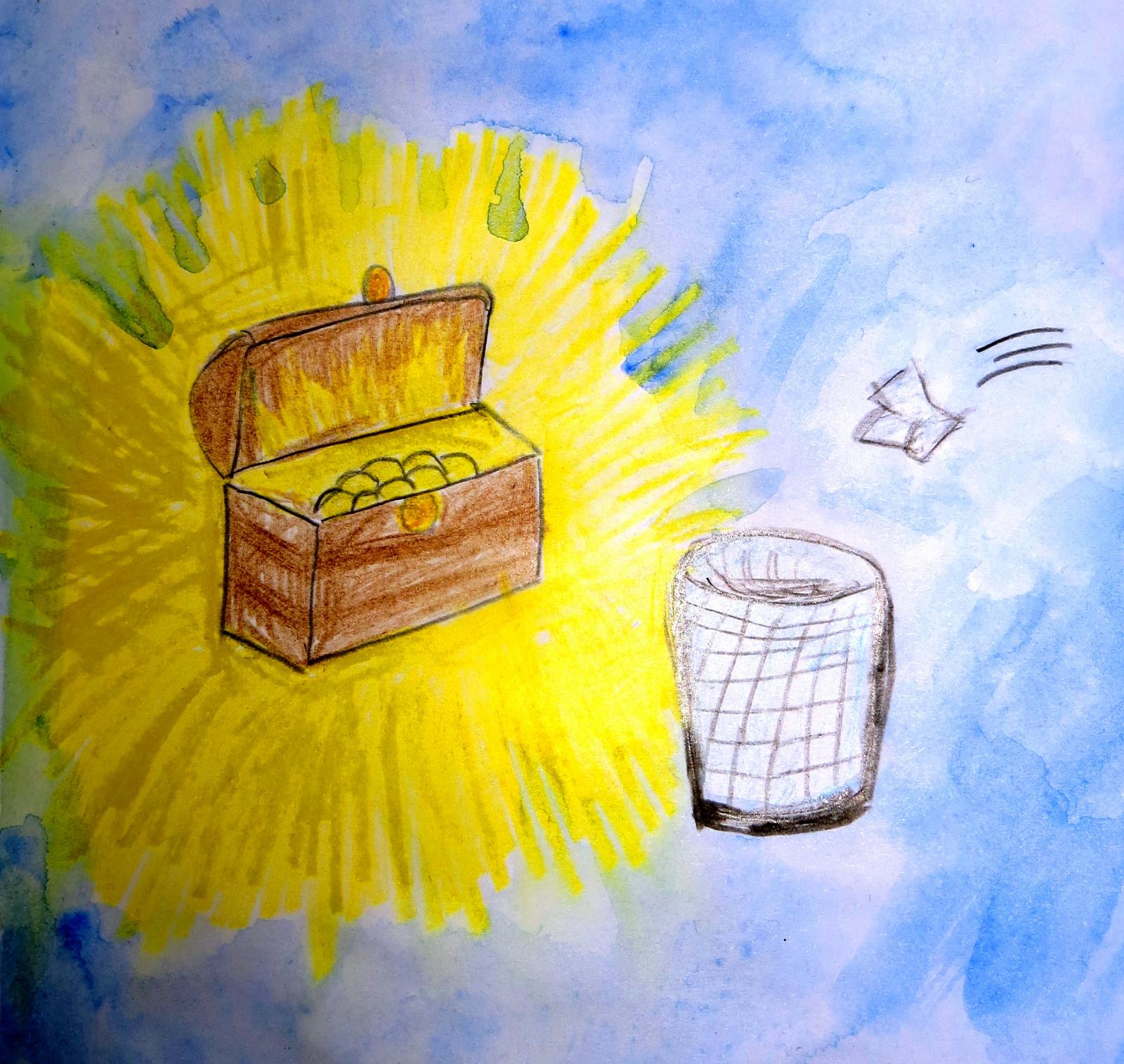
That was rubbish – but this is precious to me!
- The game leader places a treasure chest and a wastepaper basket in the middle.
- Everyone writes down on a piece of paper an experience they’ve had that day which was either: - completely pointless and silly, or - absolutely lovely and precious to them.
- The pieces of paper are then placed in either the treasure chest or the bin, as appropriate.
- The game leader reads them all out again.
- Individual incidents can now be discussed again – but there must be no debate about how each person felt.
ABC – Lists
- Required: Worksheet with the ABC – there is space next to each letter to write a word
- Participants compile ABC lists of their feelings during an activity or throughout the day (they don’t have to come up with something for every letter – the important thing is that the words apply to the person).
- They may wish to share their lists – what and how much they say is entirely up to them.
ABC – Lists – Template
Natural objects
- The participants go outside and look for an object that they would like to present to the others later.
- The object must relate to the time spent together, such as a memorable situation. However, it can also reflect the general atmosphere within the group or be linked to something the participants have learnt.
Sculptures
Material: modelling clay (or even clay)
A sculpture is created from the malleable material to illustrate the course of the past situation.
Afterwards, everyone explains their work.
Weather
The group works together to create a ‘feel-good’ display based on the weather:
- Sunny: positive experiences, good atmosphere
- Partly cloudy: good and bad aspects
- Rain: not very interesting
- Fog: not sure what to make of it
- Frost: a chilly atmosphere, feeling uncomfortable
- Thunderstorm: tensions and conflicts
- etc.
Assigning roles
In a group, everyone takes on a specific role.
To illustrate this, you can use the image of a ship. Everyone must assign themselves to one of the various roles on the ship. (Captain, first mate, helmsman, engineer, deckhand, passenger, cook...) Afterwards, you must also explain why you chose that particular role.
Alternative: The roles are assigned to each person by the others.
Reflections on the group
The ideal group
- Reflect on the last day / the last few days (perhaps with the whole group).
- Everyone thinks for themselves about how an ideal group might have acted in each situation.
- The group discusses this.
- The results may be recorded on a poster.
A simplified daily routine
- The group leader prepares a coordinate system on a poster: the horizontal axis represents the passage of time / the individual activities (waking up, morning Bible study, outdoor games...); the horizontal axis represents a points system (e.g. from -5 to +5)
- Everyone reflects for themselves on how they experienced the day / how satisfied they were in each situation
- The group discusses their thoughts, compiles them on a shared poster, and clarifies any questions...
Reflection within the group
Mood surveys
- One by one, everyone comments on the last activity or the previous day
- The others react by moving closer to or further away from that person
or:
- the facilitator reads out various statements; the participants must position themselves along an imaginary line from one end of the room (‘I agree with that’) to the other (‘I don’t agree with that at all’)
- Possible statements: It was boring; it was easy; I needed more help; the group worked well together...
Directions
The group is given the task of mapping out a route that represents their shared journey as a group.
The individual stages of this journey are symbolised by waypoints. The following questions may help: How difficult or easy were the individual sections of the journey? Were there any resources available? Were there any memorable moments with the group (highs and lows)?
Reflection for the group leader only
Quick Overview
- The group leader asks the group questions
- The participants have their eyes closed
- Everyone casts their vote using their fingers (10 fingers = 100 per cent; 1 finger = not at all)
- Possible questions: How did I feel? How did the teamwork go? Was I able to / did I contribute to the success? Am I satisfied with the decisions made?...
Image credit
- Cover image: CarolES