This devotional marked the conclusion of a Pentecost retreat on the book of Esther. The entire theme was explored from the perspective of how God works between the lines in this book.
Introduction
We spent the entire weekend studying the story of Esther. It is the only book in which God יְהוָ֥ה (you have this name printed in your workbook) is never mentioned by name. For this reason, the book was long a subject of controversy among the Jews.
Now let’s take another look at a few things together. When we examine the content of the book, several aspects stand out in particular:
The book begins with a feast. The king hosts a grand feast and invites all his ministers to attend. And the story ends with a feast. The Jews celebrate the Feast of Purim because they were saved from the great calamity that threatened them. And they still celebrate this feast today. In between, however, many things happen, and when we examine them, we also encounter God in this story.
God’s Work I: Esther Becomes Queen and Is Called to Stand Up for the Jews
Queen Vashti had been deposed by the king because she refused to attend the banquet, and he then followed the advice of his counselors. And so it came to pass that the king sought a new queen. Esther was among the candidates. Mordecai deliberately wanted Esther to say nothing about her background. She was chosen as queen from among many women. But was it really just her beauty that ultimately made her queen? Mordecai sees a very different reason behind it all. The Jews were facing increasing hardship. Haman wanted to have them all killed, so Mordecai sent word to Esther:
“Do not imagine that you will escape with your life in the king’s palace while all the other Jews are being killed! If you remain silent at this time, relief and deliverance will come to the Jews from another place. But you and your family will forfeit your lives and perish. Who knows whether you have not come to royal position for such a time as this?” (Esther 4:12–14)
Although Mordecai does not give a direct answer, I think that, in hindsight, we can say he was right. She became queen for this very purpose, and I am quite certain that behind her selection as queen stands the greatest of all kings. The One who created the heavens, the stars and planets, the earth, and everything on it.
God's Work II: Haman Wants to Exterminate the Jews and Casts the Pur
Mordecai provoked Haman to anger. He refused to bow down to him because he was a Jew. Of course, it wasn’t enough for Haman to punish just him. He wanted to exterminate the entire people of Israel. And here, something in particular stands out. Haman is deeply superstitious. He cannot determine the date for this undertaking on his own. Instead, he lets the lot (Pur) decide. The Bible states that he cast this lot in the Jewish month of Nisan. This is the first month of the year for the Jews. And the lot fell on the 13th of Adar—the 12th month of the Jewish calendar.
To illustrate, here are the 12 Jewish months:
- Nisan
- Iyar
- Sivan
- Tammuz
- Av
- Elul
- Tshiri
- Cheshvan
- Kislev
- Tevet
- Shevat (or Shvat)
- Adar
Do you see what’s happening here? There’s almost a whole year between the casting of the lot and the actual date. And Haman trusts this system. He could have simply gone to the king and asked him for it—but he trusts in the principle of his stars.
But something else becomes clear here as well. Was it really the stars that caused the dice to fall that way? Albert Einstein once said, “God does not play dice.” By that he meant that God would leave nothing to chance. Could He be behind it all after all? Did He ensure that the people of Israel still have nearly a year left to respond to this decision? I personally believe so.
God's Work III: Mordecai Saves the King's Life, and Haman Is Forced to Pay Him the Highest Honor
Some time had likely passed since Esther became queen when Mordecai overheard a plot to assassinate the king. Two eunuchs (Bigtam and Teresh) wanted to take the king’s life. Mordecai immediately turned to Esther and told her about it, and she promptly reported it to the king. The matter was investigated, the conspiracy uncovered, and the conspirators were hanged on the gallows. The king then had this event recorded in the royal chronicles.
Some time passed again. What Mordecai had done was forgotten, and the chronicle was put back in the drawer. In the meantime, Haman had already arranged for the Jews to be killed on a specific date; he had brought this before the king and succeeded in getting his way. But when Mordecai once again refused to bow down before him, Haman lost his patience and had a gallows erected on which he intended to hang Mordecai. He wanted to take this matter directly to the king. However, the king had slept poorly—or had a bad dream—that very night. The king had someone read him something—sort of like a bedtime story. Chronicles are particularly well-suited for falling asleep, so they read to him from one. But the passage read to the king was precisely the one about Mordecai. The king suddenly remembered this incident and asked, “What reward, what honor did Mordecai receive for that?” But the answer was, “None.” The king asked further, “Who is out there in the courtyard?” It was Haman, who had come to see the king regarding Mordecai in order to have his execution approved. But before Haman could say anything, the king asked him:
“What can a king do for someone to whom he wishes to bestow a special honor?”
Haman assumed the king was speaking of him and said smugly, “For the man whom the king wishes to honor in a special way, a precious robe should be brought—one that the king himself usually wears—and a horse with the royal trappings on its bridle, one that the king himself usually rides. The horse and the robe are to be handed over to one of the king’s highest officials, so that he may clothe the man whom the king wishes to honor in royal attire and lead him on the king’s horse through the city’s main square. As he does so, he is to walk ahead of the man being honored and proclaim: ‘This is how the king treats the man to whom he wishes to bestow a special honor!’”
But the king did not mean himself. He meant, of course, Mordecai, and ordered Haman to treat him exactly in this way. Haman wanted to kill Mordecai, but instead he had to bestow the greatest honor upon him.
But what actually kept the king awake that night? The Bible gives no reason for this. But I think the question needs to be phrased differently: “Who” kept the king awake that night? We don’t get an immediate answer to this question either. I do believe, however, that we can recognize God’s hand at work here as well. On that fateful night, when Haman had prepared everything for the execution, the king could not sleep. Moreover, this passage about Mordecai was read to him. Could all of this be a coincidence? I don’t think so. There is someone at work here who is not only active when we are awake but also has control over our dreams: God.
God’s Work IV: Now Everything Happens in Rapid Succession
After Haman was forced to bestow the highest honor on Mordecai, he hurried home, completely distraught and with his face covered. There he told his wife and all his friends what had happened. His wise advisors said to him: “If Mordecai, to whom this has happened, is one of the Jewish people, then you might as well give up. Your downfall is sealed.” And suddenly, everything happened in rapid succession. Even as they were saying this, the king’s servants arrived to take Haman to the banquet with the queen.
Once again, King Ahasuerus promises Esther that he would give her anything she asked for, even up to half his kingdom. But this time, Esther reveals what is weighing so heavily on her heart:
“If I have found favor in your eyes, my king, and if you are willing to grant me a request, then I plead for my life and for the life of my people. We have been sold—me and my people—and they intend to kill us, murder us, and exterminate us! If we were merely deprived of our freedom and sold into slavery, I would have remained silent and not troubled the king with this.”
The king is horrified: “Who dares to do such a thing? Where is the man who is hatching such shameful plans?” And Esther tells him: “Our mortal enemy is this wicked Haman right here!” The king storms out of the palace in a rage. Haman begs Esther for his life. The king returns, suspecting that Haman might now even attack Esther. The king’s servants immediately arrest him, and one of the royal eunuchs points out that the gallows Haman had erected for Mordecai is still standing. Haman was then hanged on it himself. Although the king’s decree to kill the Jews could not be revoked, the Jews were officially permitted to defend themselves. Many sided with the Israelites, and so they emerged with a great victory. However, one day was not enough, so they were permitted to continue destroying their enemies the following day as well. The 13th and 14th of Adar were declared holidays, and the festival of Purim was established to commemorate the deliverance that the people had experienced.
Concluding Thoughts
We have seen that God is not mentioned anywhere in the book. The question now is: Why is that? I think the reason is as follows. During the Assyrian rule over the people of Israel, God seemed so distant that the author deliberately omitted God’s name. The Jews faced such hatred—not only from Haman but also from others among the population—that many probably asked themselves at that time, “Where is God, anyway?” One more small point: It’s not just God who is omitted; prayer is also completely absent. Esther proclaimed a fast. Yet fasting is often associated with prayer in the Bible. Still, I think the people of Israel also prayed. This detail, too, was likely omitted deliberately to show that God directs history without us having a decisive influence on it—even though God rejoices in every prayer and acts in response.
All these things are missing from the Book of Esther, yet God is at work even between the lines. In our own lives, too, there can be times when God seems incredibly distant. He seems to be somewhere, but not where I’m facing my hardships, not where I have my worries—whether at school, where we might be teased by someone, in family problems, or in a dispute with a friend. In those moments, God often seems very far away. And we, too, may ask ourselves, “Where is God now?” Yet God can also work between the lines in our lives.
Unfortunately, the people of Israel had turned away from God, and God repeatedly showed them what the consequences would be. He also said that it would come to the point where they would be ruled by foreign nations. Yet God also says, through the prophet Jeremiah:
“I, the Lord, bring about everything that happens; whatever I will, comes to pass. My name is ‘The Lord.’ Call upon me, and I will answer you! I will reveal to you great things that you do not know and cannot possibly know.” Houses were torn down—even the palaces of the kings of Judah—to reinforce the walls against the Babylonians’ siege ramps and to better withstand their attacks. But the other houses were filled with the corpses of the people I had slain in my burning anger. For I had turned away from Jerusalem because its inhabitants had done so much evil. Yet now I, the Lord, the God of Israel, say: “I will bind up and heal Jerusalem’s wounds. I will restore it and grant it true, lasting peace. Yes, I will turn everything around for the good of Judah and Israel and restore them to what they once were.” (Jeremiah 32:2–7)
In the story of Esther, the people of Israel experienced that God keeps His promises. He proved that He is in control of history. God is also in control of your life, and we can take comfort in what Paul wrote to the church in Rome:
But we know this: All things work together for the good of those who love God; for they are called according to His purpose.
And a few lines later, he writes:
What more can we say now that we have considered all this? God is for us; who can stand against us? He did not even spare his own Son, but gave him up for us all. Will not everything else also be given to us along with his Son? Who will dare to bring a charge against those whom God has chosen? God himself declares them righteous. Is there anyone left who could condemn them? After all, Jesus Christ died “for them”; more than that, he was raised to life, and he “sits” at God’s right hand, interceding for us. What, then, can separate us from Christ and his love? Hardship? Fear? Persecution? Hunger? Deprivation? Danger to our lives? The sword of the executioner? “We must expect all of this,” for as Scripture says: “For your sake we are constantly in danger of death; we are treated like sheep destined for slaughter.” And yet: In all of this, we emerge with an overwhelming victory through the One who has loved us “so much.” Yes, I am convinced that neither death nor life, neither angels nor “invisible” powers, neither the present nor the future, nor “godless” forces, neither the high nor the low, nor anything else in all creation can ever separate us from the love of God that has been given to us in Jesus Christ, our Lord. (Romans 8:28, 31–39)
What does it say there? We are treated like sheep destined for slaughter. That was also the case in the time of Esther and Mordecai. But then it goes on to say: In all this, we emerge with an overwhelming victory through the One who has loved us so much. The people of Israel experienced that as well back then. God stood by them. He granted them victory. With Jesus, we are on the winning side. He remains faithful to us and, as mentioned, works even between the lines of our lives—even in places where we may not be able to recognize Him.
Materials
- Large dice for explaining the Pur (lot)
- Poster showing the 12 Jewish months
Image Credit
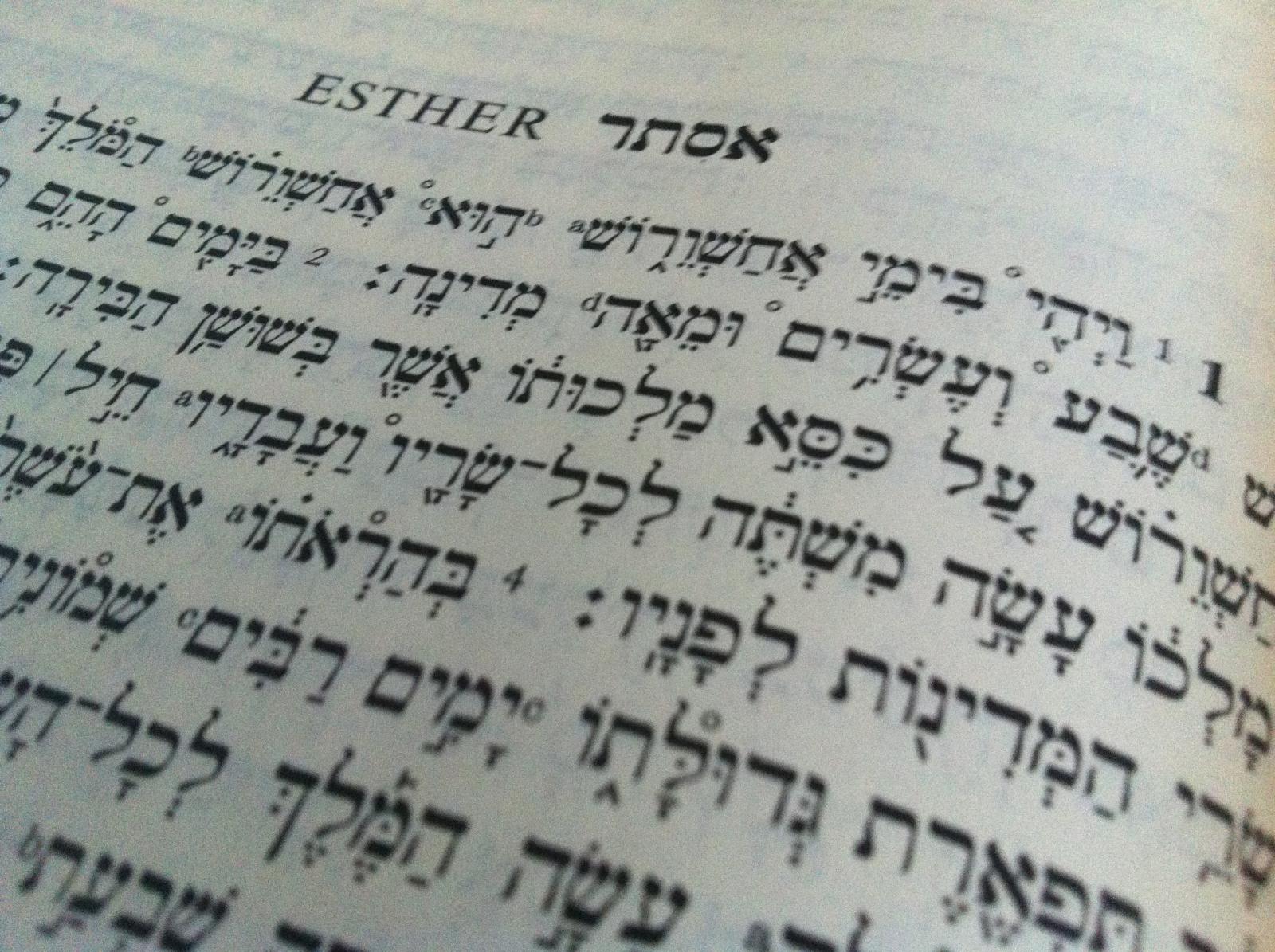
- Cover image: Detail from the Biblia Hebraica Stuttgartensia (René Graf)