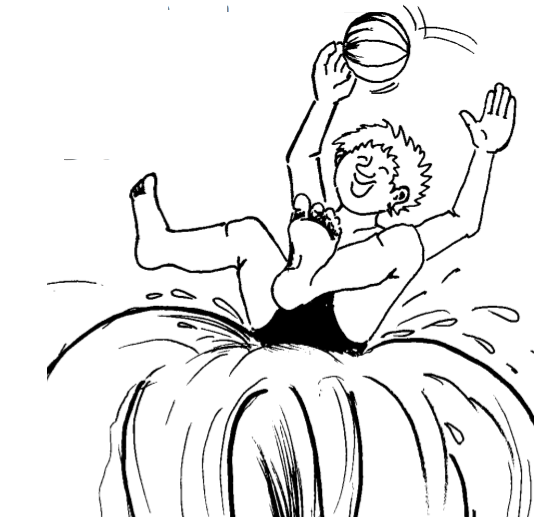
A trip to the pool requires careful planning on the part of the leaders: ideas for letting the kids burn off energy through free and guided play.
This article is from a Forum magazine issue.
Let's go swimming!
Hot, sticky skin, sweaty foreheads, dripping hair—everyone’s crying out for water. Let’s go—the youth group is meeting at the pool! To make sure you don’t end up “taking a dip” yourself, here are all kinds of tips for planning and running an afternoon at the outdoor pool.
The kids will remember an afternoon in the water for a long time to come. Water is refreshing, and fun is practically guaranteed. Organizing an afternoon in the water is different from organizing one on land. It starts with planning the trip, checking in with the lifeguard, and goes all the way through to carrying out the program. The fact that organizing games at the pool presents a slightly different challenge than on land can discourage many people. But with water games, we tap into children’s natural urge to play. For our group, playing means a shared experience. Courage, commitment, and perhaps even fear play a decisive role in this. The game leader benefits from the fact that the element of water itself is already appealing to most children. The goal is to make use of this unfamiliar element and design games in such a way that the advantages of water—such as “floating” and the reduced weight of one’s own body—come into play.
Of course, there should also be room for individual swimming and jumping, but anyone who has the courage to try a guided game in the water will realize: it’s worth it!
Game Suggestions - Relay Games:
Countless variations of transport relays, clothing relays, etc., are very well suited for use in the water. For very diverse groups,
a relay format works well, in which
each group is allotted a certain number of “wild cards.” For example, two people from each group may swim with kickboards, while another must balance a diving ring on their head. Each group has one pair of goggles per person, etc. This allows various swimming aids, such as kickboards and goggles, to be incorporated into the game.
The “encounter relay” is a format in which the weaker performance of some children can be offset by that of stronger children.
Swim Cap Pool Relay
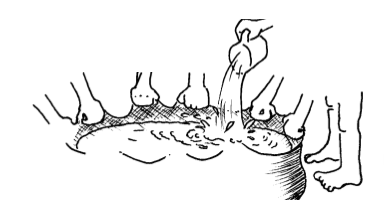
All groups receive a swim cap (a modern rubber sports swim cap) and a scoop (a liter-sized container, a cut-open fabric softener bottle, or similar). The goal is to fill the swim cap using the scoop. The participant whose turn it is swims or wades across the pool, fills the container at the opposite end, and swims back (other variations are possible, such as multiple “fills” per round—the container holds well over 100 liters). The group with the largest “bathtub” at the end of the game wins. How many children can fit inside? (Note: An adult can easily sit in a
adult can easily sit in a swim cap if it’s filled enough. Getting started is the hardest part. That’s why the groups should be large enough (6–10 children) so that the task can be completed at all.
Variation: Water Balloon Relay
Same game as above, but instead of the cap, a balloon is filled. Materials for each group: liter measuring cup, balloon, funnel for filling (quite difficult; not possible unless everyone helps...).
Ball Games: Brennball or Mattenlauf
Group A is on the field; Group B is off the field and tries to score points. A player from Group B throws the ball (or other throwing device) onto the field and sprints/wades/swims toward corner x (marked with a small board with an anchor—e.g., a plumb line to
it doesn’t drift away, or the pool edge). The group tries to form a line in front of the person with the ball as quickly as possible. The person at the back dives with the ball under the spread legs of the team members. When the person at the front surfaces, the whistle blows. Anyone who hasn’t safely reached a corner (x, y, z) by then must go back. Group B gets one point for each completed round. Group A gets one point for catching the ball. After 5 to 10 minutes, the groups switch roles. Which group scores more points?
Variations:
The swimming style or movement of Group B players is determined by rolling dice. (1=hop, 2=dive, 3=swim, 4=with a kickboard, 5=arms behind the back, 6=any way)
Board Games: Snakes and Ladders
Laminate the game board and place it on the edge of the pool. Each pair of players has a game piece. Players roll the die and move their piece. For each number rolled, a station is set up in or around the water.
For example:
1 = Jump off the diving board
2 = Go to the other end of the pool and back using a small board
3 = Slide
4 = “wobbly bridge” made of small boards or Styrofoam discs
5 = Throwing into a hoop in the water
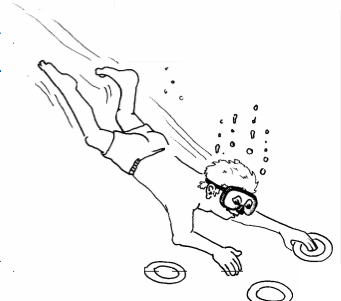
6 = Diving for 6 rings
The group may only move forward once they’ve completed the task. If they move backward on the game board ➜ they get a cold shower. If they’re allowed to move forward ➜ they get a reward.
Of course, there are no limits to your imagination. Various props can lead to countless game variations (balloons, ropes, rings, etc.). Or why not try an outdoor game (water and land) at the pool?
You’ll find plenty of game ideas and excellent suggestions in the book *Water Games for Groups* by Patrik Lehner, published by rex-Verlag.
I hope all you water lovers have a great time!!!
Tips:
- Find out in advance how many swimmers and non-swimmers will be present
- Reservation (absolutely necessary, since otherwise—unless the pool is not very crowded—games won’t be possible); you may need to cordon off part of the pool
- Plan your time so that there is room for both group games and free swimming.
- Decide in advance where the game will be explained (e.g., not right next to the slide, since it’s very noisy there)
- Have all the children get out of the water for instructions; they’ll pay better attention that way
- Agree on a meeting place and time
References

- Content and image: Forum Kind, Issue 2/03, pages 25 and 26. © Copyright www.forum-kind.ch
- Author:Sandra Oldani, certified physical education teacher