The goal is to acquire as many adjacent plots of land as possible—ones with the highest possible value—and ultimately to have the most resources.
Game Information
- Age: 6–13 years
- Number of participants: at least 16, 4 clans (groups)
- Terrain: Forest, meadow; ideal with paths
- Leaders: 4–12 people, depending on the number of participants
- Duration: 2.5 hours
Objective of the Game
The goal is to acquire as many contiguous plots of land as possible—ones with the highest possible value—and ultimately to have the most resources.
Preparation
- Divide the area into plots using bird-repellent tape
- Youth groups are divided into 4–7 clans; each clan chooses a color name (Greenhorns, Brownies...)
- Set up the “Station” and “Country Office” resource stations
Gameplay
*To achieve the goal, each clan must first gather resources.
All clans focus on this for the first 20 minutes.
*Once this time has elapsed, each clan appoints one mayor.
This mayor This mayor (together with a JS leader) manages the
clan’s campsite and its resources.
*While most players in the clan continue gathering resources after the first 20 minutes,
others (the Landrunners) gain access to California.
*There, they explore the various plots of land and compare them (price, quality, proximity to other plots, important buildings, etc.).
*Once they have decided on a plot, they go to the COUNTRY CHEF HEADQUARTERS.
*At the COUNTRY CHEF HEADQUARTERS, they must tell the chief and his advisor which plot they wish to purchase.
*If it is still available, they must deliver the resources required for the purchase there. You will then receive a stamp on your plot map and an entry in the land registry:
Initial purchase: Blue “S” stamp for “Sold”
Exchange: Red “C” stamp for “Changed”
*If the plot the clan wishes to buy has already been purchased by another clan, they have two options: 1. Either they look for another plot, or
2. they go with their covered wagon to the campsite of the relevant clan.
They then negotiate a new purchase price (exchange price) with that clan.
*Once the two clans have reached an agreement, they go together to HEADQUARTERS and make the exchange official there: a red “C” stamp in the land registry.
*Once a clan has purchased a plot of land, they can build a house on each plot using additional raw materials.
*To connect additional areas adjacent to this plot, roads must be built. However, this can only happen after a house has been built on a plot of their choosing
.
The Clans
- All children are divided into clans.
- Important: All groups must be the same size and have the same number of participants! (older/younger participants)
- Each clan has a covered wagon and its own campsite.
- All internal discussions and consultations, as well as trade negotiations with other clans (“Exchange/Change”), take place at the campsite.
- In addition, all of the clan’s resources are stored there.
- Each clan has a mayor, a resource collector, and land runners. These roles can be swapped among the participants at any time during the game.
Collecting Resources
Collecting resources involves completing various tasks.
The tasks are tailored to the specific resource. Each task must be completed twice.
- LEATHER: Stretching a linen sheet (1x = one card)
- CATTLE: Covered wagon race (40 sec = 5 cards / 50 sec = 4 cards...)
- WHEAT: Transporting millstones (20 m = 2 cards)
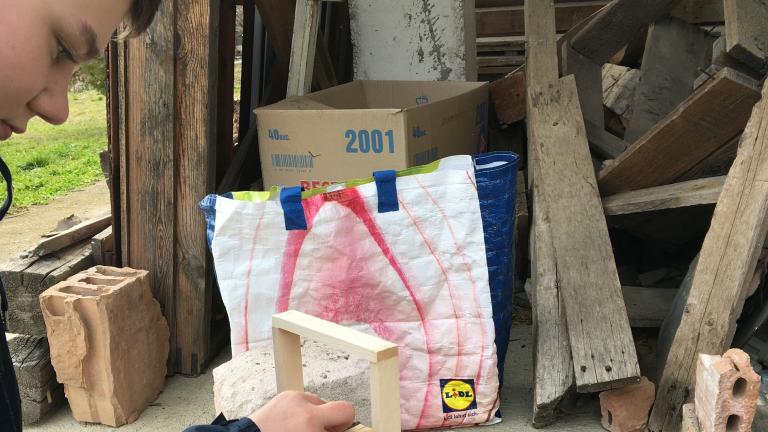
- WOOD: Sawing planks (per piece sawed = 3 cards)
- CLAY: Pitching a gable tent with 2 tarps (2 min = 5 cards / every 20 sec = 1 card)
- BRICKS: Stone-carrying (per 1 m = 1 card)
- ORE: Hammering (1 strike = 5 cards / 3s = 4 cards / 6s = 3 cards / 9s = 2 cards / 12s = 1 card)
It is entirely possible that raw material production may be suspended due to:
- NATURAL DISASTERS
- INDIAN RAIDS
- STRIKE
- HOLIDAYS
- CLOSED FOR THE FOLLOWING REASONS!
- CHURCH SERVICE
This can be used, for example, when there are too many raw materials in circulation, etc.
The Parcels
- All plots are assigned city names from the start.
- The boundaries between plots are marked with (yellow) scarecrow tape.
- In the center stands a plot sign bearing the name of the plot.
- As soon as a plot is purchased, the owner of the plot (clan name) is written on the first line.
- When a plot is exchanged (between two clans), the new owner (Clan 2) is written on the second line.
Property Values:
Lots vary in price. This depends on their location and characteristics. Those located near the government building, the train station, banks, or important saloons—or those that might contain rich mineral deposits—are more expensive than others.
Exchange Negotiations Between Clans
- These negotiations can only take place when the buyers arrive at the other clan’s campsite in their covered wagon. Only after an agreement has been reached regarding which raw materials or plots of land will be exchanged for the transfer of ownership can the parties proceed together to HEADQUARTERS.
- A plot of land can only change hands once. = red stamp “C” (Changed)
COUNTRY CHEF HEADQUARTERS: (3-HEAD)
- Country Chef: Land Registry Entry
- Advisor: Audit Office
- Treasurer: Goods Exchange/Goods Distribution (Houses & Paths)
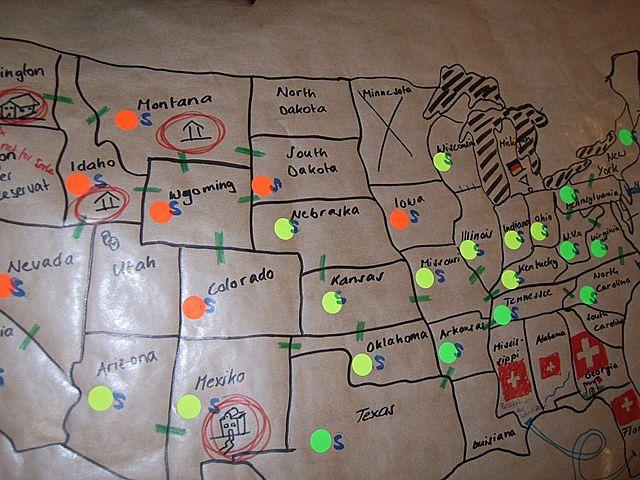
All central contract signings, etc., take place at the COUNTRY CHEF HEADQUARTERS. (It is located near the plots of land, making it easily accessible from all campsites. There is a large, detailed map of all plots of land, on which it is noted which plots are acquired by which clan (mark them on the map). As proof, the clans receive a stamp (“S” or “C”) both in the land registry and on their own map.
Houses and Roads
As soon as a clan owns a plot of land, they can build a house—and, if they wish, a road. Houses and roads are cards (C6) depicting a house or a road. These cards are attached to the plot’s sign at the respective plot.
Costs:
1 house = 20 building stones / 5 ore / 15 bricks /
1 road = 10 wood/ 12 livestock/ 5 wheat /
Houses and roads must be paid for at the Country Chef’s using the covered wagon and then transported from there to the corresponding plot.
End of the Game
The clan that purchased the most
and built houses and roads on them
. Added to this is the value of all resources at the end of the time limit.
Variations
Various elements can be used to control the game.
- Raw material collection points may be temporarily closed for the reasons described above.
- Raw material prices may go up or down (you pay more or less for the same number of raw material cards)
- Land prices may go up or down (Country Chef Headquarters)
- The entire game is also available as an “indoor” version (Lundrun Game Indoor); in this version, certain resource stations must be adjusted. The plots of land are not marked on the floor but are visible to everyone on a large map (see cover image).
Land Prices
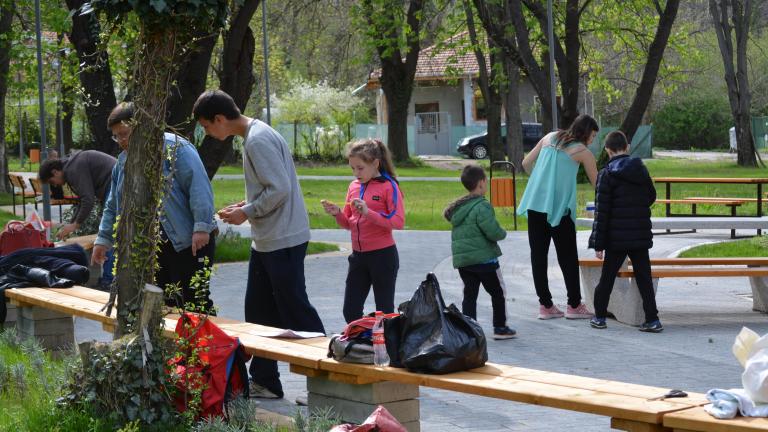
Pictures from the Lundrungame (Indoor Version)
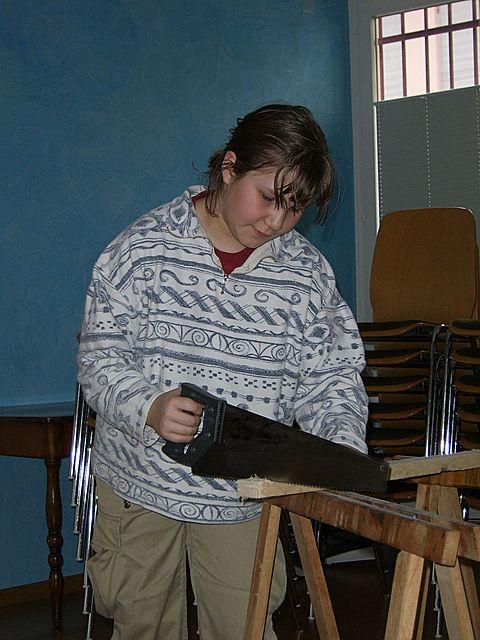
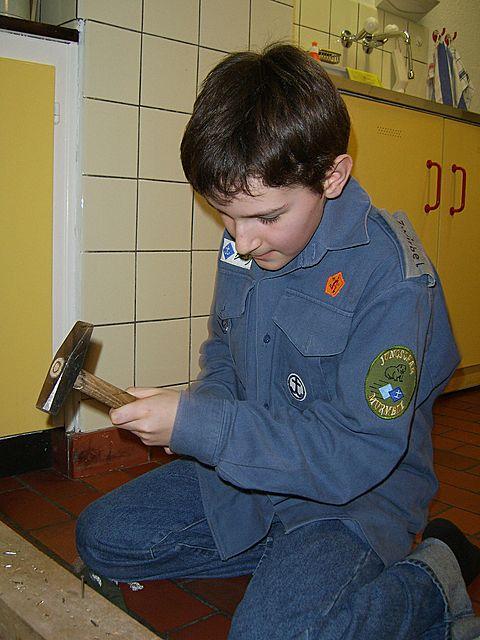
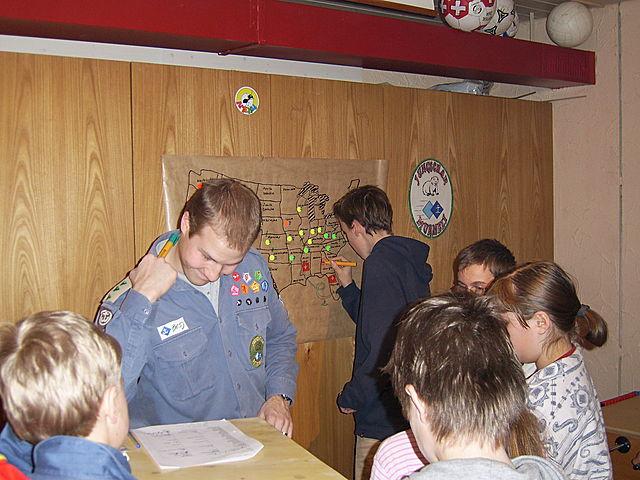
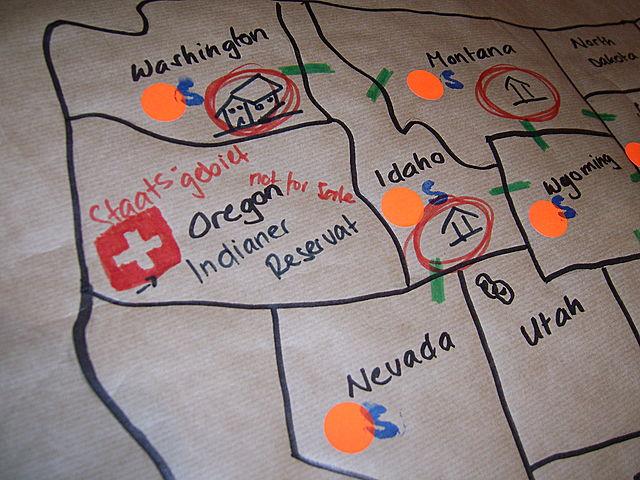
Image and Game Credits
All images are © Raphi D.; JS Murmeli, Besj Region 45
The game was developed and tested by JS Murmeli as part of a regional Pentecost camp in Region 45