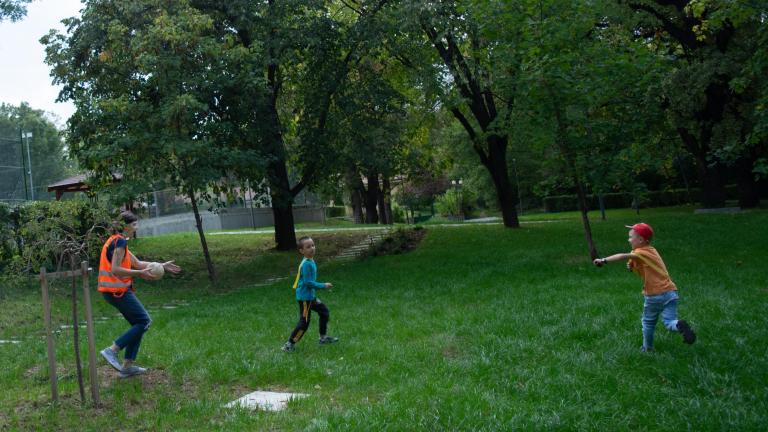
Implementation of the well-known game "On the road": the groups (forwarders) transport various goods between stations (towns) with wheelbarrows, ladder wagons... various goods between the stations (towns) and thus earn money. Further transport orders can be placed at the stations
Sketch

Idea/ back story
There is a board game called 'On the move'. This game is a realization of the game principle. The players use their truck (wheelbarrow or similar vehicle) to complete one or more haulage jobs and receive a fee for doing so. But be careful: the load is limited to a maximum of 8 goods and if the police discover that something is wrong, they'll fine you!
Game procedure
This text can be handed out in writing to the players, who form a forwarding company in groups. This way, they can also look at the rules of the game on the way and the police can refer to the fact that everyone had clear rules:
At the beginning, every forwarding company has one:
- A truck (wheelbarrow, ladder truck or similar) is provided by each forwarding company itself.
- A logbook showing what is loaded and unloaded and where.
- The forwarding account with a starting capital of 100, in which the expenses and income are noted.
- Two orders, which are distributed by the game management at the start
- A map showing the location of the stations
The game starts at the same location for all players. After the starting whistle, the individual stations can be approached. However, the players of a transport company may never separate. Goods can be picked up or unloaded at the stations. This requires transport orders, which can be purchased at any station. The individual stations naturally have different orders. Stopovers can therefore often be worthwhile. If several hauliers arrive at a station, a traffic jam occurs. They arrive in the order in which they arrive. Of course, several orders can be processed at the same time. The maximum load quantity of 8 goods may never be exceeded.
Buy transportation orders
Required: Shipping account
There are always three orders for sale at the stations, any number of which can be bought at once. Once one of the three orders has been sold, the station manager reveals a new one. This can then also be bought at the same time. However, the account balance must never slip into the red! The station manager enters the new account balance and signs it.
Pick up goods
Required: Transport order, logbook, free loading capacity An order can only be executed in full or not at all. Splitting is not possible! The station manager enters the loading location, unloading location, revenue, number and type of goods in the logbook and signs it. On the transport order, he makes a cross in the boxes (boxes on the pallet) or crosses them out. The order is then deemed to have been "accepted". He also hands over the goods. He is not interested in the loading capacity!
Unloading goods
Required: Transport order, logbook, forwarding account
The station manager deletes the order from the logbook and signs it. He credits the freight proceeds to the forwarding account. If necessary, he checks the transport order again for conformity before destroying it.
Loading capacity
Each truck has a capacity of 8 goods, which must not be exceeded. Even if it appears that more can be loaded!
Police
Needed: Orders, logbook, possibly shipping account :-(
During the game, "On the road" police officers are on the road. They check whether more or fewer goods have been loaded than entered in the logbook. If the loading capacity is not correct, a fine of 200.00 per missing or overloaded item is due. The police also cause traffic jams, detour, etc.
End of the game
Two events lead to the end of the game:
1. The time has run out (announce the end time to everyone before starting!). The stations close. Missions that have not been fully completed no longer yield any income. Even those that have already been loaded.
2. A forwarder has no more orders and there are no more to buy. The game is over for him, but everyone else can still complete their orders (until the end time).
The winner is the player with the most money at the end of the game.
Posts/ Groups/ Leaders
Station manager tasks
At the stations (cities):
Orders sold
Required: Shipping account
There are always three orders for sale at the stations, any number of which can be bought at once. Once one of the three orders has been sold, the station manager reveals a new one. This can then also be bought at the same time. However, the account balance must never slip into the red! The station manager enters the new account balance and signs it.
Goods charged
Required: Transport order, logbook, free loading capacity
An order can only be executed in full or not at all. Splitting is not possible! The station manager enters the loading location, unloading location, revenue, number and type of goods in the logbook and signs it. On the transport order, he makes a cross in the boxes (boxes on the pallet) or crosses them out. The order is then deemed to have been "accepted". He also hands over the goods. If there are too few goods, give them a corresponding number of notes instead! Please write the type of goods on it and sign it! The loading capacity is not important!
Goods unloaded
Required: Transport order, logbook, forwarding account
The station manager deletes the order from the logbook and signs it. He credits the freight proceeds to the forwarding account. If necessary, he checks the transport order again for conformity before destroying it.
Police officer tasks
Important: The police officers should run separately, otherwise they can easily be bypassed.
Check load
Required: Orders, logbook, possibly forwarding account :-(
Each truck has a capacity of 8 goods, which must not be exceeded. Even if it appears that more can be loaded! Anyone who has loaded more or fewer goods than stated in the logbook, or who exceeds the loading capacity, pays 200.00 per missing or excess good. The police can check anywhere and at any time. Between two fines, however, the truck must have stopped at a station so that the haulier has the chance to correct his "mistake".
Traffic jams, detours, roadblocks
The game can be made more exciting by setting up traffic obstacles.
Remarks
It is advisable to play the board game variant at the first preparation meeting. Then everyone knows what the game is about.
Time of day: during the day
Venue: in the village, in the city
Number of leaders: At least 8, ideally 11 leaders
Number of participants: At least 20 participants, maximum 100 participants
Age group: 8-16 year olds
Origin: Youth group of the CVJM Nöttingen e.V.
Stations
10 stations (towns) are determined in the town, whereby the greatest distance (e.g. between the northernmost and southernmost) should be approx. 1 km.
Game variation: On the city map that each group receives, only the location of the towns is noted, the names must be found out (town signs at the stations, meaningful names, e.g. "Mühlhausen" at the mill, "Death Valley" at the cemetery).
Goods:We had 4 different goods, but it also works with fewer. With more, the game becomes confusing. There are only 2 of the 4 goods at each station.
120 egg cartons distributed over stations 1,2,5,6,8,9,10
100 cobblestones distributed over stations 1,3,4,6,7,9,10
20 wooden boards distributed to stations 2,5 45
Stuffed animals distributed to stations 3,4,7,8
Orders
Each participating forwarding agent (14 in the test) needs 20 orders in 3 hours (empirical value).
Number of orders per station (where these goods are available): Stones and egg cartons 17 per station, animals 10 per station, wood 5 per station
There are orders with 2 to 6 goods.
Goods are only transported to stations where they are already available, e.g. stones from station 1 to 3, but not from station 1 to 2.
If you create a counter order for each order, a goods cycle is created. So if there is an order for "6 animals from Mühlhausen to Death Valley", then there is also an order for "6 animals from Death Valley to Mühlhausen". At some point in the game, these animals will be transported back again and the risk of running out of goods is reduced. The revenue from an order depends on the distance, the number and the type of goods (stones, for example, bring in more than egg cartons because they are heavier). The profit per good should not exceed 200, otherwise overloading is profitable. As there are no identical orders with so many variations, unfortunately they all have to be written by hand.
The orders are shuffled and distributed to the stations. If you buy an order at a station, it does not necessarily start there!
Material
- Invitations
- Game rules
- Logbooks
- Shipping account
- Orders
- Location maps
- Safety vest, waving trowel, little hat (for the police)
- Certificates and prizes for the winners
- 120 egg cartons
- 100 cobblestones
- 20 wooden boards
- 45 stuffed animals
- Town signs
- Forwarding signs (each forwarding company comes up with a name and hangs the sign on the truck)
- Notepad for the station manager (in case goods run out)
Source reference
- Game idea:
Courtesy of www.spielboerse.ch - Spielideen für die Jungschar! - Image:
www.flickr.com