Trekking encompasses a wide variety of activities. Everything from goal-oriented hikes to river trekking is included. Often, participants’ motivation can be boosted by choosing a specific type of trek. This article compiles every conceivable type of trek.
Types of Trekking
- 12/24-Hour Trekking Activities
Go as far as possible in groups within 12 or 24 hours; night hiking is also possible. Suitable only for older participants. Especially during 24-hour activities, it’s important to ensure that the groups don’t push themselves too hard and that everyone has a great experience (including the slowest participants). - 24-Hour Hiking Project
Small groups hike a route that may not be announced until the day before. The groups must find their own places to spend the night (at a farm or in a bivouac). This can be conducted either with a leader supervising each group or with only older participants. - Contemplative Hike
A quiet (and possibly more individual) hike during which participants are given prompts for reflection and contemplation (e.g., after a prayer service). Also suitable as a torchlight hike. Best suited for older participants. - "Direttissima" (Following a Line Precisely)
Follow a border, coordinate, contour line, ridge, or self-drawn line as closely as possible without deviating. Caution: Prioritize safety. - River Trekking
Follow a body of water as closely as possible for as long as possible. For example, from a spring to the mouth of a river or similar. Caution: Prioritize safety / Trekking in swimwear or wet clothes is not recommended - Night Hike
Experience-oriented trekking at night. The focus is on the trekking itself; that is, participants should not feel intimidated or similar. - Project-Based Hiking
Geography projects, local history, natural history, historical projects, etc., should be explored during a hike - Treasure Hunt
While scouting the route, the leaders bury one or more treasures in small wooden boxes, which are then unearthed during the hike itself (1–3 months later). Important: Document the treasure’s location well with photos, etc. Experience has shown that it is quite difficult to find the treasures again. No valuables should be buried. - Star Hike
Different groups start from different starting points and meet up at the destination. - Full Moon Hike
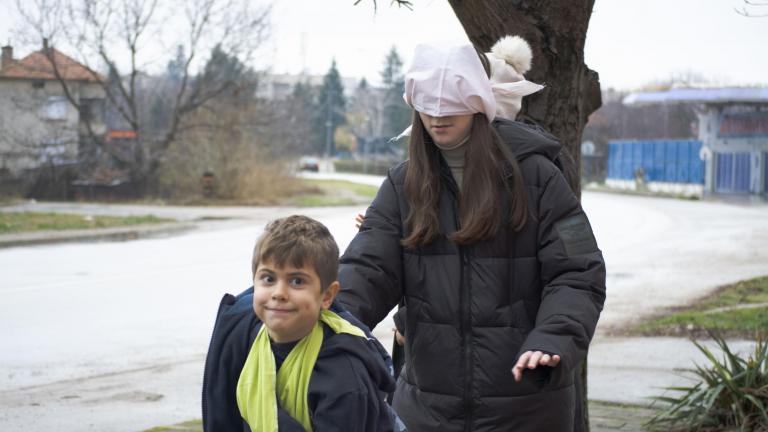
Similar to a night hike, but without flashlights—only by moonlight. Possible only on easy terrain and when the sky is clear. - Hiking with Orientation Challenges
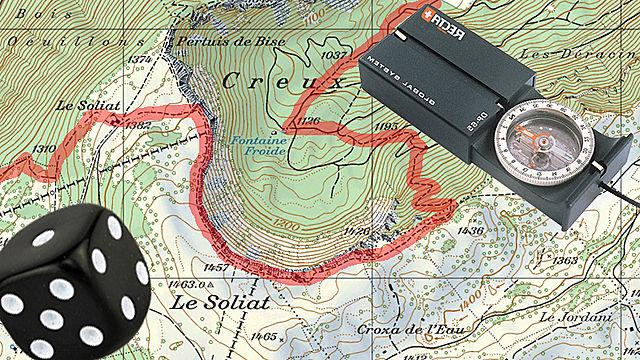
The children must follow a route using coordinates, sketches, tracks, photos, a compass, etc. - Dice Hike (Five-Liber Hike)
Within a specific time frame, participants roll a dieor flip a coin at each intersection to determine which way to go. Can also be organized as a competition (Who can get the farthest away? etc.) --> game of chance. This type of trekking is not suitable for the (Pre-)Alps.
Source Citation
- Cover image: Courtesy of Jungschar Schinznach / Manuel Meier
- Contents: including the J+S brochure “Trekking—On the Move”