Trekking umfasst sehr viele mögliche Tätigkeiten. Von zielorientierten Märschen bis zum Flusstrekking ist alles enthalten. Oft kann die Motivation der Teilnehmer durch die Anwendung einer speziellen Trekkingform gesteigert werden. Dieser Artikel sammelt alle erdenklichen Trekkingformen.
Types of Trekking
- 12/24-Hour Trekking Activities
Go as far as possible in groups within 12 or 24 hours; night hiking is also possible. Suitable only for older participants. Especially during 24-hour activities, it’s important to ensure that the groups don’t push themselves too hard and that everyone has a great experience (including the slowest participants). - 24-Hour Hiking Project
Small groups hike a route that may not be announced until the day before. The groups must find their own places to spend the night (at a farm or in a bivouac). This can be conducted either with a leader supervising each group or with only older participants. - Contemplative Hike
A quiet (and possibly more individual) hike during which participants are given prompts for reflection and contemplation (e.g., after a prayer service). Also suitable as a torchlight hike. Best suited for older participants. - "Direttissima" (Following a Line Precisely)
Follow a border, coordinate, contour line, ridge, or self-drawn line as closely as possible without deviating. Caution: Prioritize safety. - River Trekking
Follow a body of water as closely as possible for as long as possible. For example, from a spring to the mouth of a river or similar. Caution: Prioritize safety / Trekking in swimwear or wet clothes is not recommended - Night Hike
Experience-oriented trekking at night. The focus is on the trekking itself; that is, participants should not feel intimidated or similar. - Project-Based Hiking
Geography projects, local history, natural history, historical projects, etc., should be explored during a hike - Treasure Hunt
While scouting the route, the leaders bury one or more treasures in small wooden boxes, which are then unearthed during the hike itself (1–3 months later). Important: Document the treasure’s location well with photos, etc. Experience has shown that it is quite difficult to find the treasures again. No valuables should be buried. - Star Hike
Different groups start from different starting points and meet up at the destination. - Full Moon Hike
Similar to a night hike, but without flashlights—only by moonlight. Possible only on easy terrain and when the sky is clear. - Hiking with Orientation Challenges
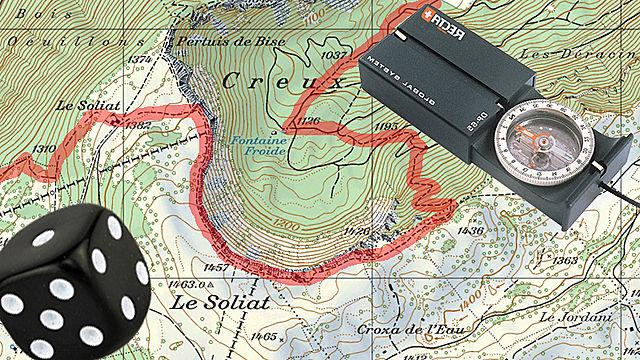
The children must follow a route using coordinates, sketches, tracks, photos, a compass, etc. - Dice Hike (Five-Liber Hike)
Within a specific time frame, participants roll a dieor flip a coin at each intersection to determine which way to go. Can also be organized as a competition (Who can get the farthest away? etc.) --> game of chance. This type of trekking is not suitable for the (Pre-)Alps.
Source Citation
- Cover image: Courtesy of Jungschar Schinznach / Manuel Meier
- Contents: including the J+S brochure “Trekking—On the Move”
- Anmelden oder Registrieren, um Kommentare verfassen zu können