Spiel und Sport sind hervorragende Möglichkeiten, sich zu bewegen, sich in der Leistungsfähigkeit zu verbessern und soziale Umgangsformen zu erwerben. Immer nur trainieren macht aber nicht besonders Spass: mit einem tollen Turnier erhalten die erworbenen Fähigkeiten einen geeigneten Rahmen, sich vergleichend zu messen.
Bei diesem Artikel handelt es sich um einen Forum Heft-Artikel.
Tournaments with children
Regardless of whether it is a team or individual sport or simply a game: Many tournament forms can be adapted to your own situation with little effort. Anyone organizing tournaments with children should first ask themselves some basic questions:
- What are our goals? To find the strongest player, the strongest team? Is the main thing fun?
- Do the players already know each other? How much time is available?
- How many teams/players are taking part?
- Can luck play a role?
Ideally, not only one-game or one-sport tournaments are held in the youth group work, but also a combination of different games. This allows children with different strengths to compete with each other. Not only the "mono-player", but also the "polysportive" should have a chance.
"Unlucky" tournaments
The following section presents tournaments in which luck plays no or only a minor role.
The rotation tournament
Goals:
- All play against all
- The performance level is checked
In the rotation tournament, each team plays against each other. If there is an odd number of teams, a break post is introduced. In this type of tournament, different games can also be played on the pitches; in this case, all teams rotate.
Variant:
In the case of equal games, points scored are "carried over" to the next game; for football with team A-H: the first game A:B ends 3:1. A starts the second game against C with a score of 3:1, B against E with 1:3.
The imperial tournament
Objective:
- The best player is chosen
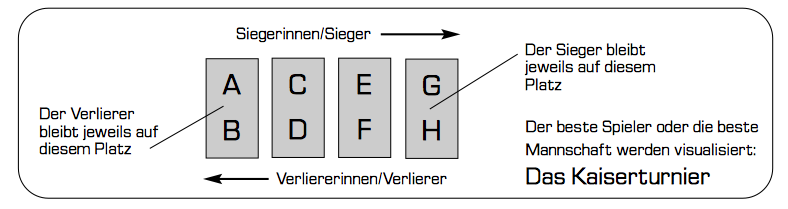
In the emperor's tournament, the teams are distributed over the playing fields. In this case, an even number of teams is required. At the end of the playing time/if the winner is determined, the losers move one game to the left and the winners to the right. The loser who has already played on the far left or the winner on the right remains on the pitch.
Variation with sitting ball
All players start in the middle square. Whoever has been hit moves one square to the left, whoever has been hit moves one square to the right.
The classic: the knockout tournament
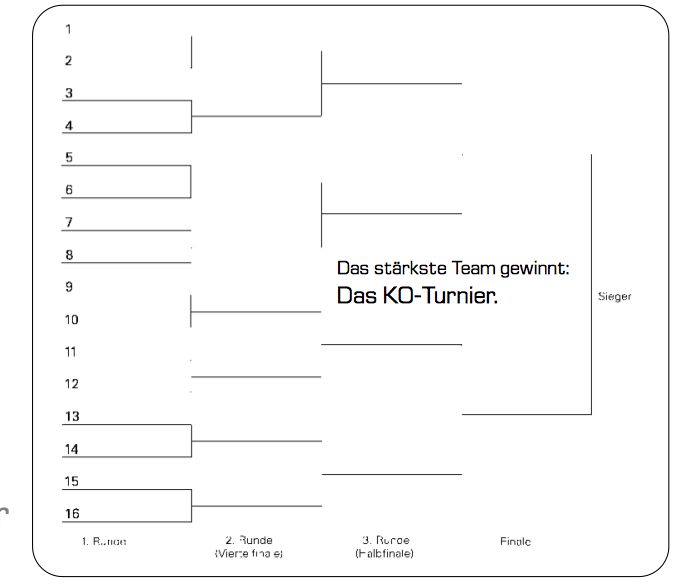
Probably the best-known form is the knockout tournament: most official tournaments take place according to this mode.
The aim is to determine the strongest team.
If the strengths of the participants are known from the past, the best are placed as far away as possible in the tableau. Each winner advances to the next round, while the losers are eliminated.
With this tournament, the best player can be determined in a small number of matches.
Tournaments with a luck factor
Children's work is often more about fun and social skills than about measuring sporting ability. This is where the luck factor can add a lot of variety to the action.
Draw tournament
In the draw tournament, the game partners are drawn by lot. This can be done, for example, by drawing a Jass card, with numbered tokens, etc. The playing fields must be clearly labeled, in the example with the Jass cards with 6, 7, pawn, ace.
Variant:
In team games, the team compositions can also be drawn, e.g. kings: Aces, Pawns-Queens, 9:8, etc.
Important: Each player must note down the points scored.
Monte Carlo method
The Monte Carlo method is not actually a form of tournament. Rather, the random factor is integrated into some form of tournament. This randomly changes the rating.
Examples:
- From time to time, the next point or goal is given five times the value.
- From time to time, a short game (e.g. a quarter of the normal playing time) is played.
- Every third point is worth three times as many points.
- Net faults count double, women's goals/left goals triple etc.
The handicap tournament
In the handicap tournament, either double points or smaller playing fields can be awarded to the weaker players (e.g. known from the previous Kaiserturnier), depending on the ideas of the organizers.
A number of differently sized playing fields can also be defined and allocated by lot.
A Swiss specialty: the Kästli tournament
Objective:
- Each player plays the same number of games
- Everyone plays as many games as possible against players of equal strength
In this form, the strongest players are seeded as far apart as possible in the tableau, as in the knockout tournament. Weaker players are assigned an opponent. In the second round, the winners and losers play among themselves and so on.
If there is an uneven number of teams/players, the players who have dropped out are awarded a forfeit victory.
To compile the ranking list, each participant's victory points plus the points of the players they have won against during the tournament are added together.

Further ideas for game tournaments
can be found in the JS brochure "Turnierformen", booklet no. 30.80.055d, available from dok.js [at] baspo.admin.ch (dok[dot]js[at]baspo[dot]admin[dot]ch).
You can find more game tables on the Internet at www.sport.admin.ch/dok_js/ upload/771_turnierp_e_e.pdf
Source reference

- Content and picture: Forum Kind issue 2/05, page 19 + 20 © Copyright www.forum-kind.ch
- Author: Lori Keller
- Anmelden oder Registrieren, um Kommentare verfassen zu können