Dieser Lektionsvorschlag handelt von der Geschichte des Gelähmten und seiner 4 Freunde
Bei diesem Artikel handelt es sich um einen Forum Heft-Artikel.
Devotion/lesson: Four great friends
Who doesn't know the story of the paralyzed man and his four friends? It shows us that Jesus knows us through and through and wants to help us.
The following version of the story is also suitable for children who think they already know everything!
Getting started
Show the children various things related to the doctor or illness (plasters, bandages, thermometer, stethoscope, etc.). Talk to the children to find out why or when you need all of this. In the course of the conversation, you should come to the conclusion that there are illnesses that cannot be easily seen from the outside - special equipment (devices) are needed to find out (ultrasound, X-ray, etc.). Often invisible diseases (e.g. cancer, AIDS) are more dangerous than visible injuries (e.g. abrasions).
After this part, move on to the biblical story: There is someone who knows us so well, who doesn't need any apparatuses, who sees right into our hearts and knows how we really are. Who is that?
Spontaneous theater
The biblical story can be performed very well as spontaneous theater. To do this, call all the younger children to the front. A small, light child goes to the back. There are 4 leaders or teenagers with a cloth. The child plays the paralyzed man and lies down on the cloth.
The plenary leader now tells the story. The children act out what happens spontaneously.
- The group at the front plays the audience in the crowd around the house.
- The friends can't get through, the audience won't let them pass.
- They discover the stairs and go up to the roof (take a detour, don't go through the audience).
- They lay their friend on the ground there.
- The four friends make a hole in the roof.
- They let their friend (lift up the cloth with the child and slowly put it down where the hole is) through the hole in front of Jesus' feet.
The plenary leader tells what Jesus said to him: "Your sins are forgiven. Two children from the audience can now react: What did he say? Surely only God can do that? What does he actually mean, etc.
The plenary leader takes this up and tells what Jesus said afterwards. The child then stands up, takes the cloth and goes to his or her place. The other children are then also sent to their places.
The plenary leader explains to the children that we are "sick" on the inside (sin). This is not visible from the outside. But this sickness (sin) leads to death (eternally separated from God, lost). Jesus sees this, he knows us and wants to help us. He died for our sins and can forgive us our debts. This is much more important: it is better for our "heart" to be healthy and for us to be saved than for us to have a healthy body but be lost. Jesus knows this, which is why he first forgave the paralytic's sins. By healing him, Jesus then only proved that he has the power to forgive sins.
Indentation
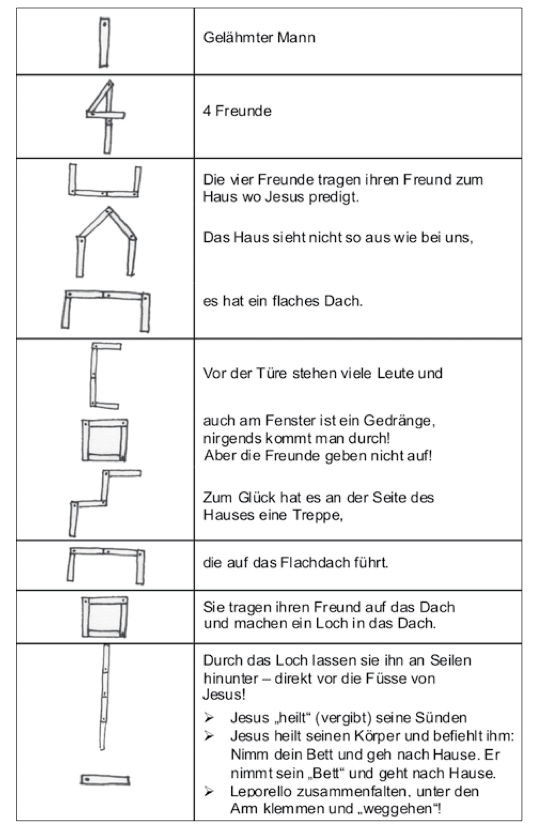
Everyone receives 4 cardboard strips (2 cardboard strips with 2 holes and 2 cardboard strips with 1 hole) and 3 pattern clips. Place the strips on top of each other and staple them together with the pattern staples. Make sure that all the pieces are on top of each other in the same direction! The children can now use the Leporello to retell the story they heard (Mark 2:2-12 / Luke 5:17-26). Think again about why Jesus first forgave the sins and only later healed the illness.
Source reference

- Content and picture: Forum Kind issue 2/09, page 12. This suggested lesson is about the story of the paralyzed man and his 4 friends. © Copyright www.forum-kind.ch
- Author: Mirjam Leuenberger, VFMG children's secretary
- Anmelden oder Registrieren, um Kommentare verfassen zu können