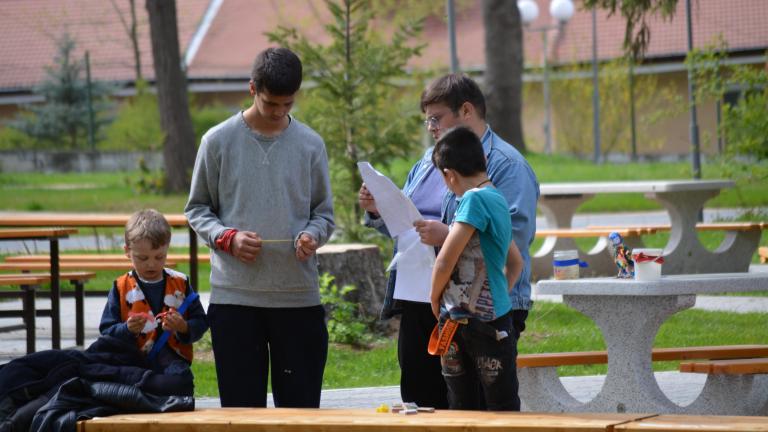
Damit Kinder Spass an Mutproben haben und gute Erinnerungen behalten, müssen einige Dinge beachtet werden.
Bei diesem Artikel handelt es sich um einen Forum Heft-Artikel.
Activity/confidence game: Tests of courage
Let a snail crawl across your face, reach blindly into a pot of cold spaghetti, drink cod liver oil, crawl through a manhole or be kidnapped by a masked member of the congregation. Who can endure this without batting an eyelid?
What do we have to bear in mind with tests of courage, scary courses or baptisms of names so that the children really enjoy them? Tests of courage should not be a traumatic experience for children.
Little children - big heroes
Even small children love to show courage and dare to do the unusual. I remember two tests of courage from my early school days. One consisted of having your hand licked by a calf, and those who were really brave dared to stick their whole hand into the calf's mouth. The other test was a little more gruesome: who would dare to go into the animal carcass collection point and close the door behind them? Afterwards, we felt like real heroes.
Scared children - courageous leaders
A terrifying experience in my first year of Jungschi was going through a dark sewage tunnel. When we were in the middle of it, shots rang out at the end of the tunnel.
Today, I maintain that the tunnel crossing could have been a "heroic experience" if it hadn't been for the "criminal with the scare shots". An idea that our leaders had incorporated because they assumed that it would be a test of courage from their point of view. However, if the dark, wet tunnel had instilled enough fear in us children to test our courage, the leaders felt that much more was needed.
So that the fun doesn't turn into a trauma
As a leader, you should bear the following in mind when planning:
- voluntary Tests of courage should be voluntary. As
- Leaders, we can motivate and encourage the children to dare, but never use coercion or manipulation.
- no peer pressure It is also our job to ensure that no child dares to do something they are not ready to do because of peer pressure. Prevent sayings such as: "You're a coward!" or "If you don't jump down there, you're no longer one of us!"
- lead by example Don't ask the children to do anything that you are not prepared to do yourself or even lead the way. It helps many children if the leader goes through the tunnel first, drinks from the "scary potion" first, etc.
- observe and record ideas Observe the children as they play and find out what overcomes them or ask them for ideas for a test of courage.
- Offer an alternative If, for example, it is a rite of passage or naming ceremony that every child has to take part in, you should have an alternative ready that can be chosen. For example, some children find it terribly difficult to put something disgusting in their mouths. In this case, have an alternative ready that has nothing to do with food or drink. The same applies to the dark, touching, confined spaces (a tube in a sheet), social challenges, singing to the children, etc.
Small children - big challenges
Here are a few possible examples of tests of courage for children aged 6-9:
- "Scary potion" made from ketchup, vinegar,
- Honey, syrup etc.
- Food dyed with food coloring, such as blue spaghetti, purple vanilla cream or grey milk rice
- Vanilla cream or gray rice pudding
- Eating a lychee (slippery)
- Put a piece of effervescent tablet or crumbled Spruso sweets (or other sweets with a tingling effect) on the tongue
- Place a Slimy or Silly Putty in the hand (with eyes closed). You can find a possible recipe for the disgusting porridge in the article on p. 24.
- Walk through a dark tunnel (with a ladder) or along a rope through the dark cellar or blindfolded through the church hall
- Hold snails, ants, spiders etc. in your hand
- Stroking animals
- Ring the neighbor's doorbell and ask for a roll of toilet paper
- Slide down a steep slide
- Climb up a rope ladder
- Complete a course barefoot (possibly blindfolded) (leaves, wet rags, sand, paste, pebbles, sandpaper, feathers)
- Blindly being handed various objects and recognizing what they are (ice cubes, bread dough, piece of fur, wet sponge)
- Smell different spice jars (caraway, garlic, curry or cheese rind, washing powder)
- Walk over a rope bridge, ride down a cable car
Source reference

- Content and picture: Forum Kind issue 2/10, page 29 © Copyright www.forum-kind.ch
- Author: Barbara Pfister
- Anmelden oder Registrieren, um Kommentare verfassen zu können