"Samaritan Stories": Many Activity Suggestions for Three Different Age Groups on the Theme of Helping
This article is from the Forum magazine.
Brutally beaten, robbed, and left for dead!
What sounds like a headline from the daily news is what Jesus told his disciples.
A story about a mugging, with practical tips on how to intervene courageously.
The following ideas, suitable for all age groups, were carried out as part of a children’s week. Duration: approximately one hour.
Attacked and Robbed
The story of the Good Samaritan from Luke 10:25–37 is well-known, yet it never fails to be compelling and moving. To begin, the parable
- is presented as a newspaper article
- and told with four characters
- illustrated with a drawing on the board
- and read aloud from the Bible.
Afterward, small groups discuss what this story is trying to teach us. One hour is set aside for fun and educational activities.
Volunteer Pass for 4- to 6-Year-Olds
A fun scavenger hunt where helpers are needed.
Each child receives a helper pass featuring the symbols for the five stations. Next to each symbol is a space for a stamp. The stations are briefly introduced at the start. Afterward, the children may decide the order themselves in pairs.
At each station, the supervisor makes a brief connection to the story to help the children understand it better.
- Apply band-aids to parts of the body marked with “blood.” If necessary, dab the “wound” dry and disinfect it.
- Use two slats and a cloth to make a stretcher for carrying a large bear. The route goes up and down stairs and must, of course, be completed without the bear falling out.
- Fill a cup with water and carry it along a laid-out rope to the injured person. Use a syringe to administer the water.
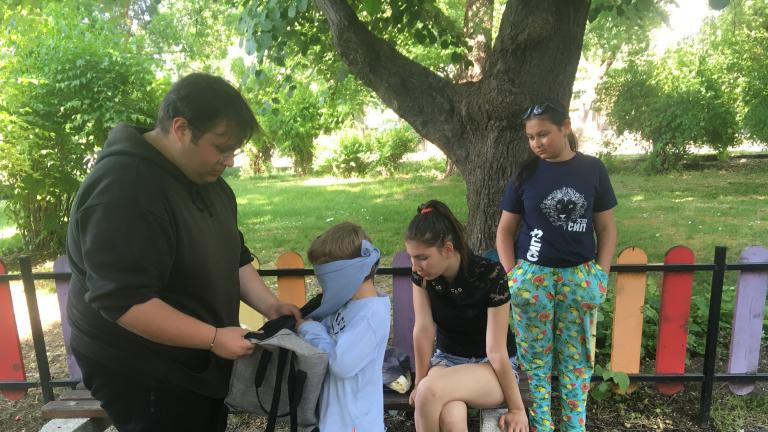
- Identify various foods in a bag by touch and match them to a picture. Variation: Identify apples, carrots, cucumbers, bananas, etc., by taste.
- Earn money by catching ten fish. Foam rubber fish with pipe cleaner loops are floating in a wading pool and must be caught with a fishing hook.
Once the task is completed, the children receive a stamp on their helper pass. They also receive a syringe as a souvenir.
Heart, Kidney, Gallbladder, where are you?
Creative activity ideas for 7- to 8-year-olds
- A life-size cardboard figure is equipped with all the major organs. Using a water squirt gun, the children must hit an organ. What is it called, and what does it do?
- A race and an obstacle course are completed using crutches. In pairs, participants can also attempt a blindfolded run. It’s important that the children have enough time to experiment.
- A right-angled elbow must be wrapped as securely and neatly as possible with an elastic bandage. Try this on the knee or foot as well.
- Fold a box with a matching lid out of paper. Fill it with band-aids, ointments, toothpaste, a small syringe, etc.
Drugstores and pharmacies are happy to provide a few samples. It’s worth the effort, as the samples are highly sought after by the children. Syringes are available from a doctor or veterinarian.
Keeping a Cool Head in Heated Scenes
Action with 9- to 12-Year-Olds
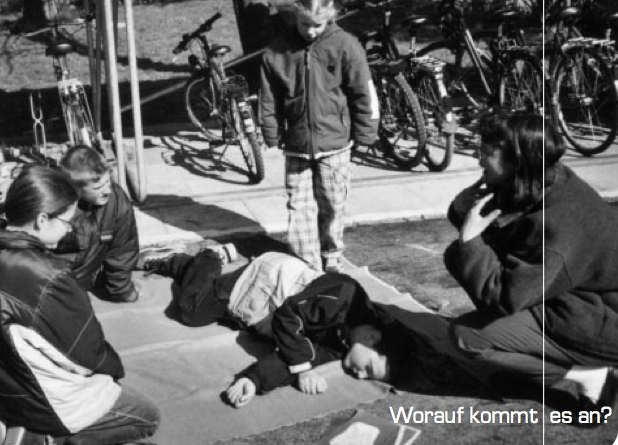
Simulated accidents have a special appeal. The key is to act thoughtfully and keep a cool head.
Each station includes a theoretical component and a practical application. It’s important to ensure that all children have the opportunity to get hands-on.
The “accident victims” were the oldest children, who had been prepared for their roles the day before.
1. First steps in an accident: “
” (Assess the situation, prevent further damage, evaluate the victim). The mnemonic “GABI” helps us with this.
G: Is he responding?
A Is he breathing ?
B Is he bleeding ?
I s his pulse normal?
2. Rescue:
If there is no suspicion of a spinal injury, evacuation may be necessary. Place one of the injured person’s arms across their chest and grasp it from behind. This allows the children to carry each other a short distance. On grassy ground, a foot-drag carry is also possible.
3. Stopping Bleeding, Applying Bandages:
The injured body part must be elevated, and pressure applied to the artery in the direction of the heart. Pressure is applied to the bandage using a stone or a firm object. A laceration on the leg (using ketchup or fake blood) must be properly bandaged.
4. Burns and frostbite
look surprisingly similar. Roll people with burns on the ground or wrap them in a blanket. Immediately cool burned body parts in water to prevent further damage. Use makeup to create a burn that must be cooled as quickly as possible. Who gets their patient into the water first?
5. Positioning
Unconscious: Recovery position
Shock: Elevate the legs
Heatstroke: Elevate the head and apply cold compresses
After a brief description of the incident, the children must place the patient in the appropriate position.
A syringe with a sticker that reads, “Be a Good Samaritan, Too!” makes a great parting gift or keepsake .
Warning: a water-spray fight is inevitable!
References

- Content and image: Forum Kind, Issue 4/03, pages 17–18. Outdoors: A tricky situation for cool heads. © Copyright www.forum-kind.ch
- Author:Christine Eugster, mother of three schoolchildren, works as a flute teacher and runs the KIDS TREFF in Felben-Pfyn.