
Recently modified articles
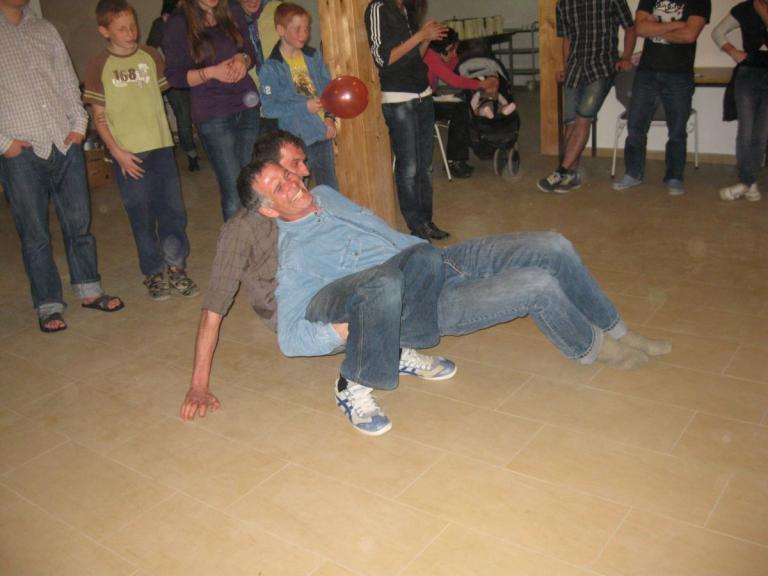
Participants are divided into two or more mixed teams based on gender, age, weight, etc.
A “battle” area is marked off—a smooth, flat surface where potentially dangerous obstacles have been removed—and two people at a time (from opposing teams) face off.
The starting position is on the back, with the soles of the feet and palms firmly planted on the ground, without the pelvis touching the ground. The goal of the two opponents is to destabilize the other by pushing, pulling, or using other strategies, without striking them. When one of them touches the ground with their pelvis, they lose and are out of the game. The team that lasts the longest in the ring wins.
No equipment is needed.

A terrain game on the theme of Indians/Cowboys/Wild West or similar...
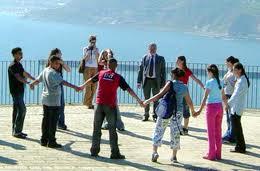
PLEASE NOTE the participants' ages; young children may get hurt. Preferred age group: teenagers or young adults.
Participants form a circle, standing two steps apart from one another.
The leader, standing in the middle of the circle, raises their clasped hands above their head and, letting out a battle cry, points them at someone in the circle. The person targeted mimics drawing a sword (the right hand goes to the left hip and is raised above the head) and shouts “HA!”, while the participants to their left and right—the left hand for the person on the left, and the right hand for the person on the right—point toward the abdomen of the person in the middle, letting out the same battle cries.
When someone makes a mistake, the game stops and everyone begins to clap their hands and tap their knees three times, after which they all point at the person who made the mistake. That person steps out of the circle and runs a lap, then returns to their place. If more than one person is singled out, they all step out and run.
After they return, everyone stretches out their hands, shakes them, and chants “aaaaaaaaaaaaaaa” until someone takes the initiative and says “I have the power” while pointing their clasped hands at someone in the circle.
If several people do this at the same time, the game stops again, and the clapping, kneeling, searching for the culprits, and running laps resume.
The game is very engaging if it starts at a slow pace and builds up to a brisk one.
No materials are needed.
Image source: http://rexfoundation.org/2006/12/16/the-parents-circle-%E2%80%93-bereav…
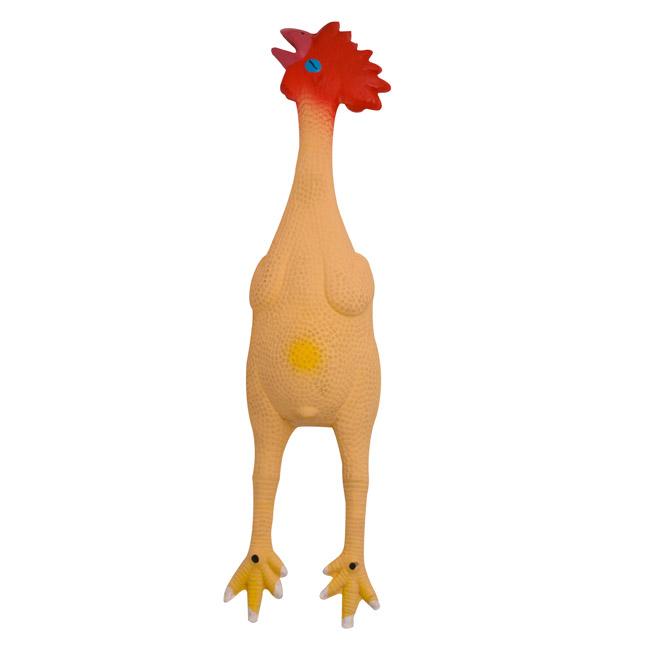
Materials needed: a rubber or plastic chicken or any other animal (preferably not made of plush, because it can get dirty)
Participants are divided into two teams; a playing field is marked off—divided into two halves—taking into account the number of participants, and free of obstacles.
The leader throws the chicken or other mascot onto the field after giving the signal to start the game. The players in the half where the chicken lands quickly form a line behind the mascot. Once everyone is in position, the person at the front passes the chicken between their legs to the person behind them. The mascot must move as quickly as possible through the space between the participants’ legs until it reaches the last person. Each person in the line, while helping the chicken move forward, also says their name. The last person in line runs with the chicken in front of the line, shouts “STOI,” and throws the chicken into the opposing team’s half of the field.
In this phase, the opposing team’s players form a line behind the chicken, while the player who threw the chicken must run around his own team, which forms a tight circle (similar to American football), until he hears the command “STOI” from the other team. The laps run around their own team count as points.
The game continues until a predetermined score is reached.
The game is extremely dynamic and fun; it’s best played outdoors.
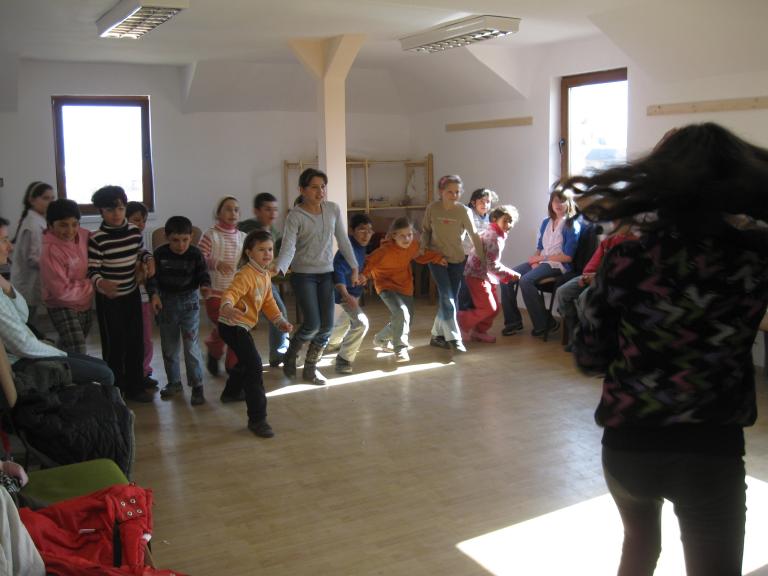
Participants line up at a distance of approximately 3–6 meters from the leader.
The leader will stand with their back to the participants.
At the start, participants try to move as quietly and smoothly as possible so that the leader cannot hear them. The goal is to reach the leader and take their place. From time to time, unexpectedly, the leader will give the command “freeze” and turn around. This is the moment when the participants must freeze. If the leader spots someone who has moved, that person will be asked to return to where they started.
The person who reaches the front first will take the leader’s place, and the game will resume.
No materials are needed.
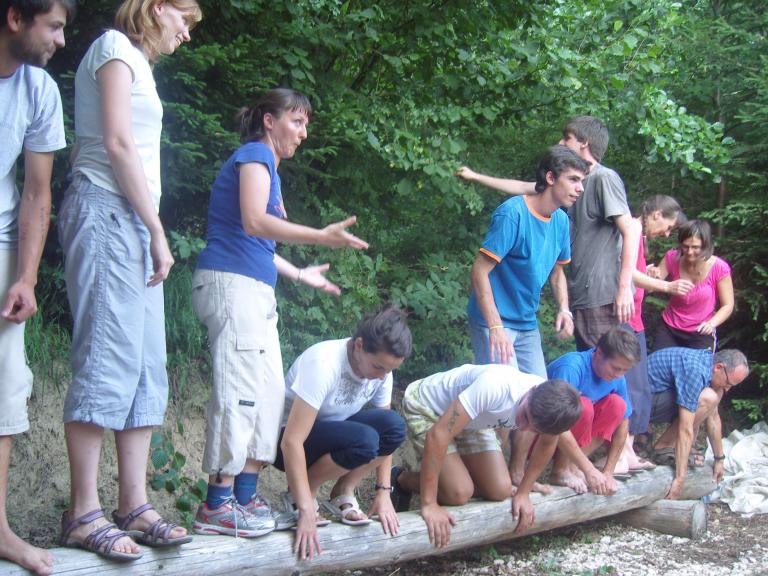
Materials needed: a log long enough for all of us to fit on it
Participants are invited to climb onto the log in random order.
They must complete the following tasks:
- Within a time limit (3 minutes), arrange themselves in alphabetical order by first name, from left to right, without touching the ground more than 5 times.
- Time trial: Arrange themselves in ascending order by age, without touching the ground more than 3 times
- Time trial: without speaking, line up in descending order by shoe size, without touching the ground at all.
Other fun challenges can be added. The time limit can be adjusted depending on how well they do.
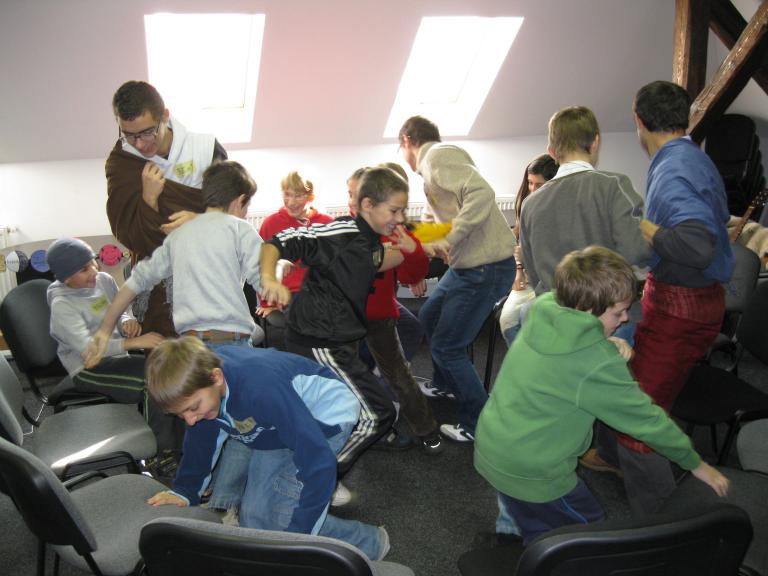
Materials needed: as many chairs as there are participants, minus one
The participants sit in their chairs. A volunteer stands in the center and states an idea: “I’ve never broken a leg.” Everyone who has broken a leg stands up and switches seats. The person in the middle tries to find a seat. Those who stand up from their chairs are not allowed to take the seat next to them.
TIP: The statements must be true for the person saying them. The ideas should be creative and apply to as many people as possible (e.g., “I’ve never skipped school,” “I’ve never gotten a 4 in Romanian,” etc.).
Materials needed: balloons, depending on the number of teams
Participants are divided into two teams (5–12 people). The teams form a line (with hands on shoulders or hips); the last person in each line receives a balloon attached to their pant leg. Within a marked-off area, the task for both teams is to pop the other team’s balloon while protecting their own.
TIP: Make sure the leaders of the two lines are of the same gender.
Image source: http://www.flickr.com/photos/jomsphotography/4084620391/
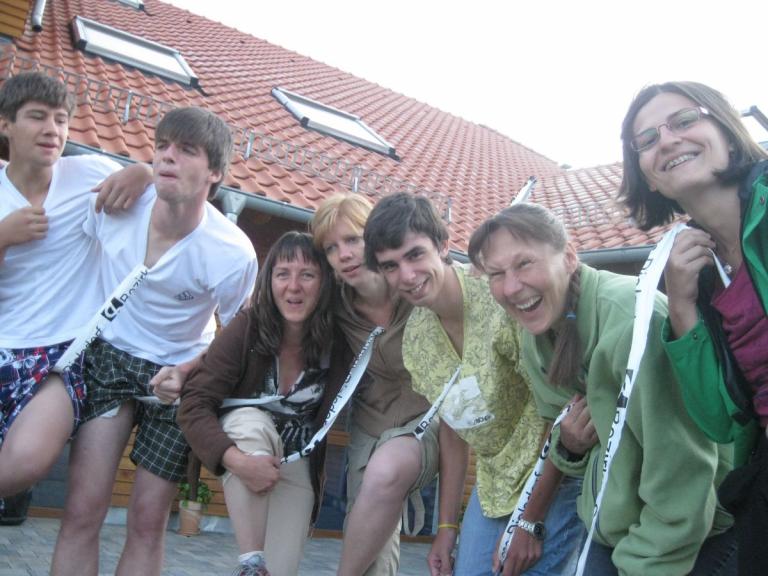
Materials needed: [one frozen spoon (placed in the freezer the night before), tied to a long piece of string or twine, depending on the number of participants (allow 1 m per person)] x number of teams
Participants are divided into 2 teams (between 4 and 12 members). Team members line up shoulder to shoulder in 2 parallel lines. The spoons with the ribbon or string wrapped around them are handed out to the teams. At the start, the task is to pass the “frozen” spoon under the clothes (shirt and pants) of all participants and back, then hand off the spoon with the ribbon or string wrapped around it exactly as they received it. All in record time. The team that finishes first wins.
An excellent icebreaker game.
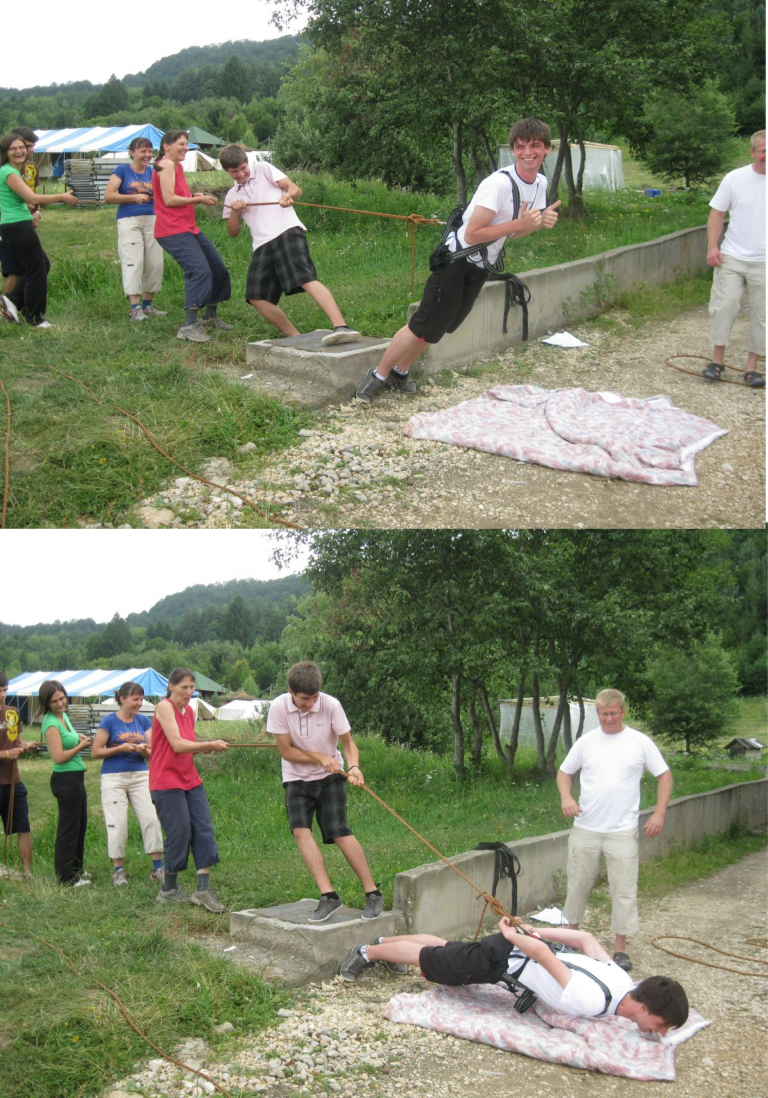
Materials needed: 1 harness, carabiner, rope, tarp/blanket—if there are many participants, you can double the materials to save time
Depending on the number of participants, two teams are formed.
One at a time, each participant will be fitted with the harness; the team’s task is to use physical strength to support the volunteer, lowering him gradually—without jerking him—until his nose touches the blanket, after which they lift him back up.
The volunteer is allowed to give commands such as “stop,” “slower,” “faster,” etc. Team members line up behind the volunteer and work together as a team.
For more information, see the accompanying images.
This program was created for Poland as food for thought. The weekly plan could be done like this. However, it has more ideas on a separate sheet what you could still do.
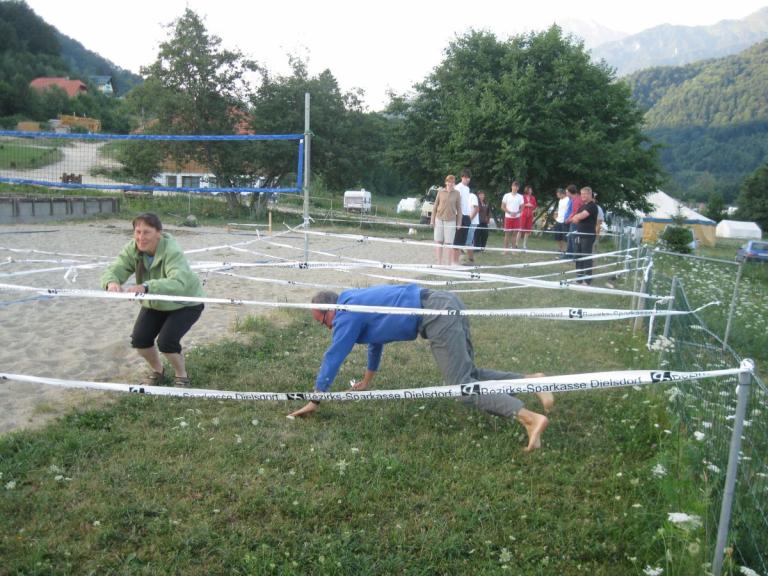
Equipment: area marked off with tape
Participants are divided into two teams that compete in a relay race. Everyone must crawl under the tape and perform a squat (girls) or a push-up (boys). After completing the task, they return to their team and pass the baton.
For more details, see the image and video.
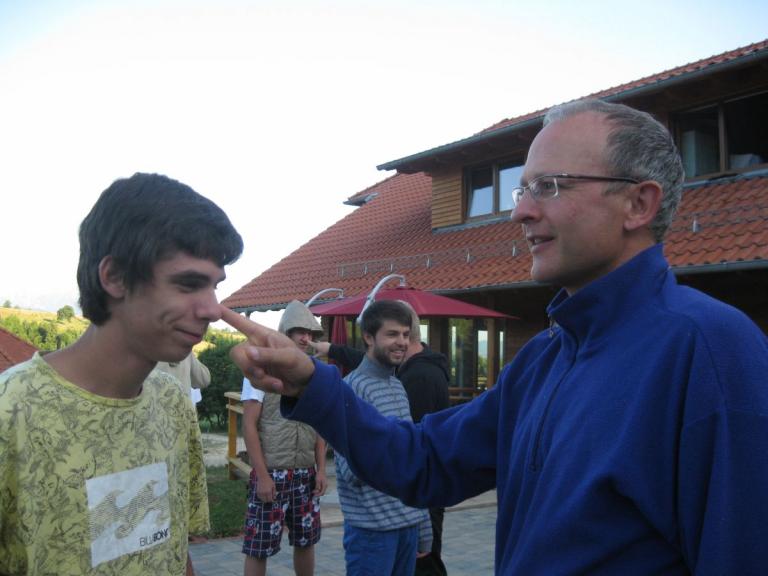
For a group of teenagers—it doesn’t matter how many, as long as it’s an even number—the commands might be something like: head to nose, knee to stomach, fist under the chin, head to head, kick to the buttocks, elbow to the solar plexus, foot to the shin, sole of the foot to the abdomen, finger to/in the nose, head to the abdomen, hand to the throat, knee to the forehead, head to the back, sole of the foot to the shoulder, etc.
No materials are required.
For a group of children, the commands may differ to avoid the risk of injury: fist to fist, palm to ankle, little finger to little finger, back of the head to back of the head, shin to abdomen, shin to back of the head, ankle to back of the head, palm to mouth, etc.
Once the participants get the hang of it, the pace can be increased and the last pair can be eliminated, until only one winner remains.
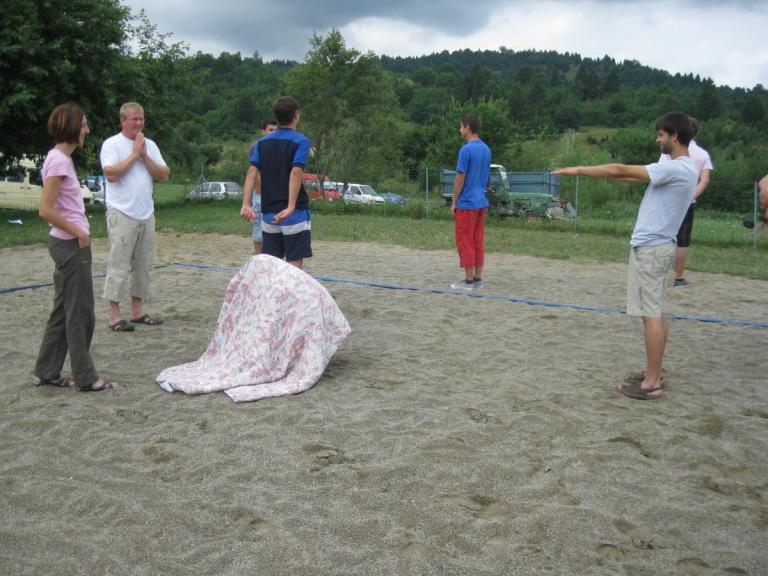
Materials: a blanket, tarp, or large piece of fabric
Participants walk around with their eyes closed and their arms outstretched within a designated area. At some point, the trainer will approach someone, touch them, and drape a blanket over them. At the sound signal, everyone stops and opens their eyes. The RULE is that no one is allowed to turn their head or look around. Each person will name who they see within their field of vision, without moving their head. After the group guesses who is missing (who is hidden under the blanket), the game resumes.
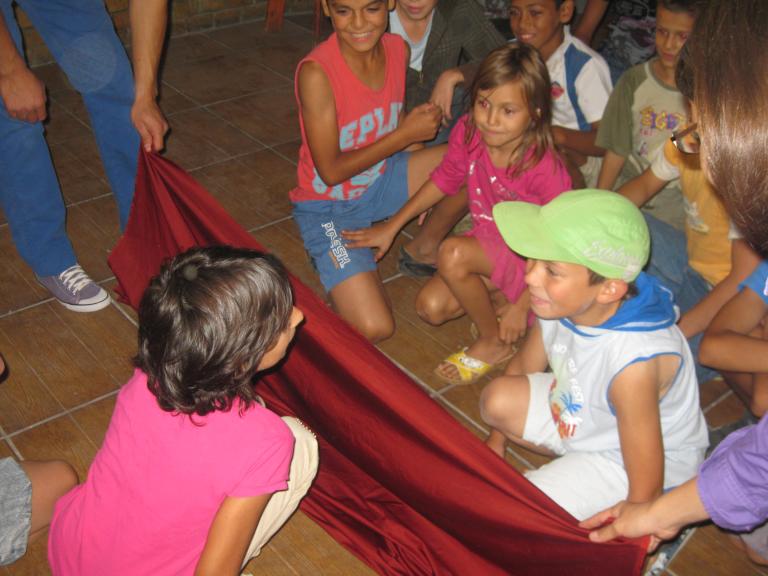
Materials: a blanket/tarpaulin/piece of fabric
Participants are divided into 2 teams (5–20 children). Before that, everyone goes around introducing themselves, once or twice.
Two leaders stand between the two teams, holding the blanket up so that the two teams cannot see each other. The rule is that, one at a time, the teams designate a representative to stand in front of or behind the blanket. After counting to 3, the leaders lower the blanket so the two can see each other. The first one to say the other’s name wins, and the loser switches to the opposing team. After a few rounds, the blanket is lowered without warning. The team with the most children at the end wins.
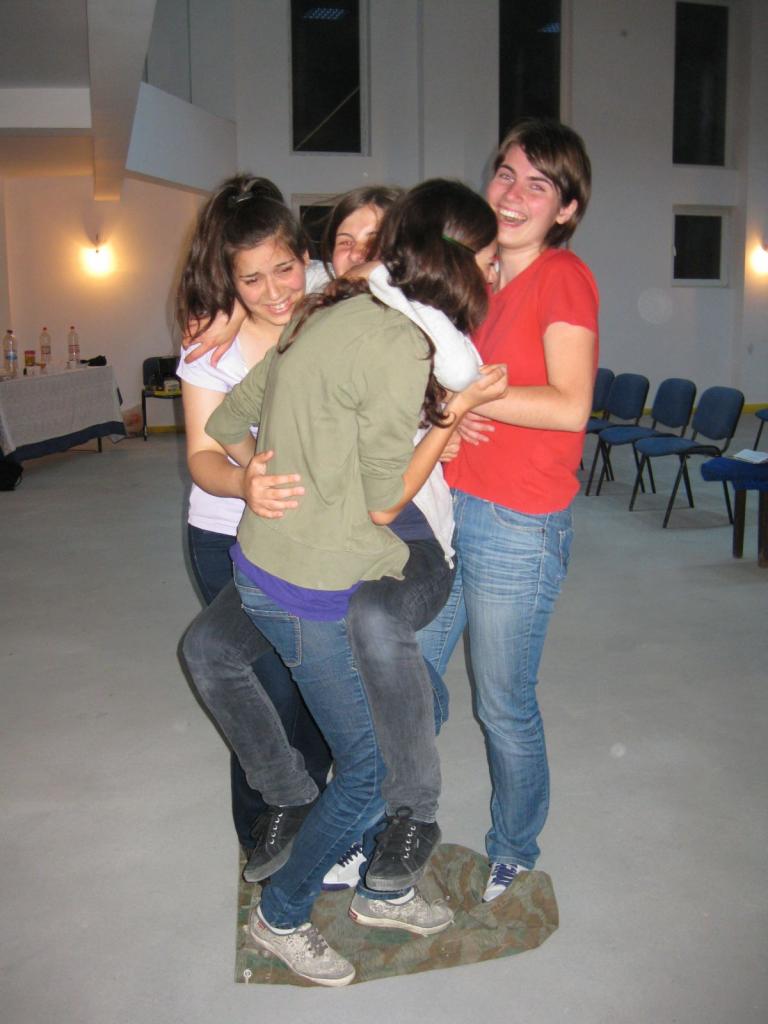
Materials needed: a folded tarp or a blanket / piece of fabric × number of groups
Participants are divided into groups of 4–8 people and all climb onto the tarp.
They are told that they are at a bazaar in Turkey and a merchant is offering them a very good deal on a magic rug that will take them home faster. The only thing they need to keep in mind for it to work is that if it rains, it must be wet on both sides.
They’re now flying at an altitude of 10,000 meters. They’re almost home; but… It’s starting to rain in heavy drops… the magic carpet is beginning to lose altitude… they have to flip it over to the other side as quickly as possible, or they’ll all die!
The teams have 5 minutes to figure out how to flip the mat over without anyone falling off.
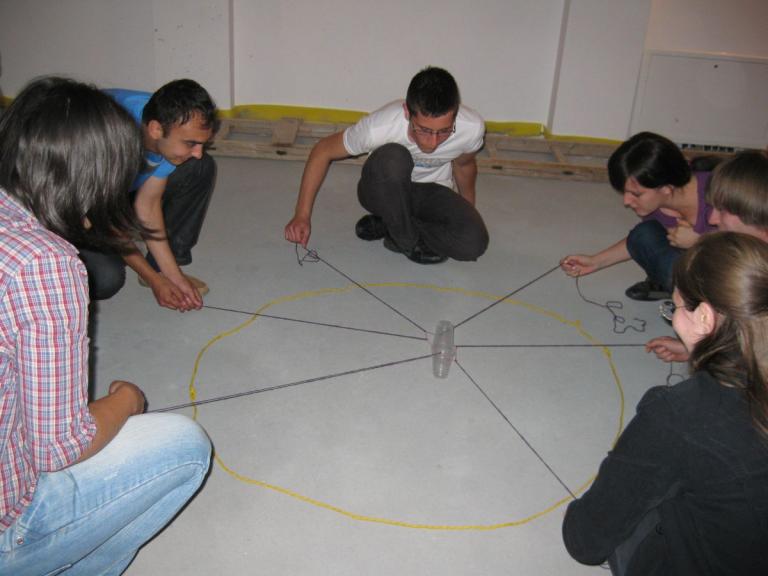
Materials needed: (one rubber band, 6 pieces of string approx. 1 m long, one circular piece of string, 2 disposable cups) x 2 or as many as there are teams
Participants are divided into 2 or more teams (of 6 people each) and are given the materials listed above, arranged as shown in the accompanying image.
Participants are told that the nuclear reactor has broken down and it is up to them to repair it in time to save their city from a nuclear disaster. Therefore, they must work as a team to quickly find the best strategy for forming a cone by stacking the two middle cups on top of each other. To avoid endangering their lives during the repair process, no one is allowed to go beyond the edge of the concentric string. The only way to handle the cups is by using the strings attached to the rubber band.
You may set a time limit before the game begins to emphasize its competitive aspect.
CAUTION: A flat surface is required for the game to work properly.
Materials: planks, wire, carabiners, a ball, a plastic bottle, a hammer, and any other items that could serve as accessories.
Participants are divided into teams of approximately 4–10 members.